
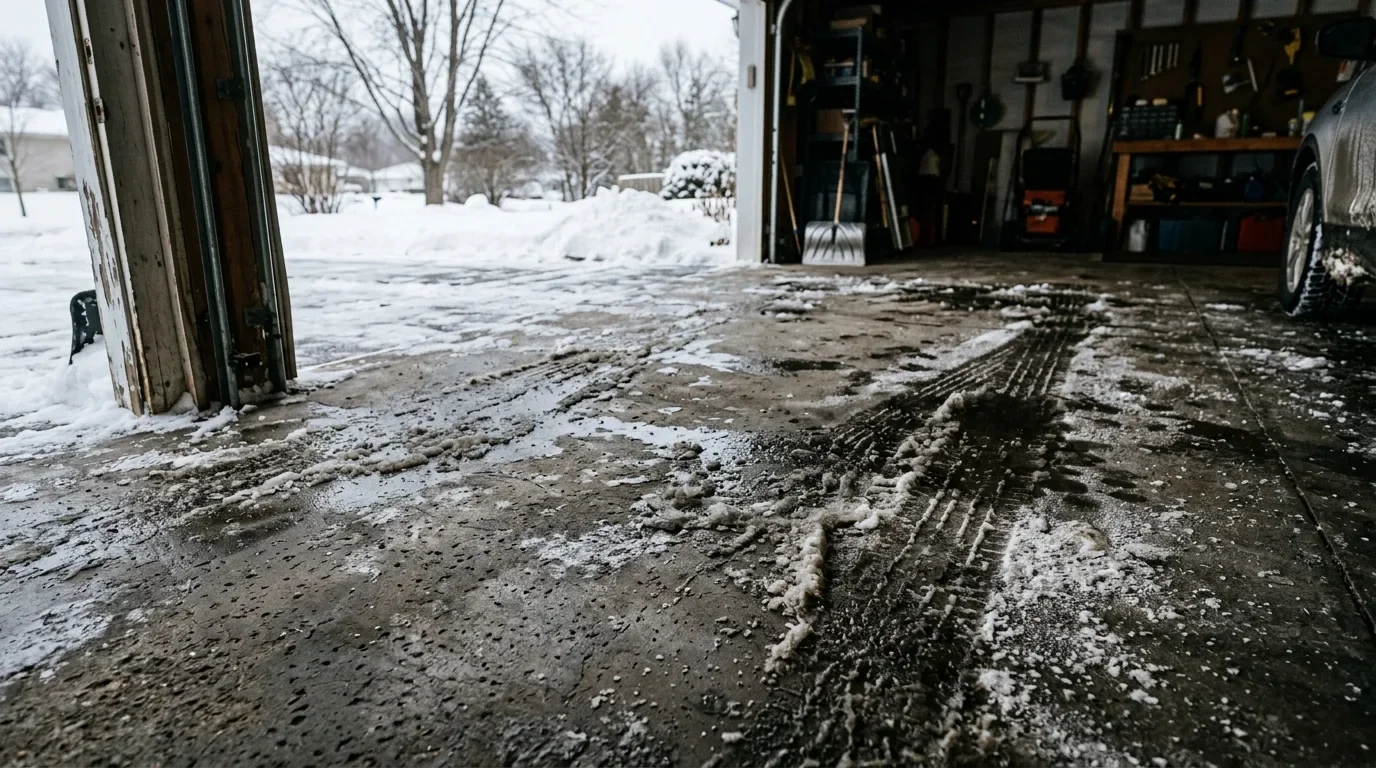
Why epoxy yellows in sunlight
Standard epoxy yellows because ultraviolet light breaks down its chemistry. Coating-industry testing found that aromatic epoxy resins and amine curing agents have poor UV resistance, with substantial yellowing, gloss loss, and even delamination after accelerated UV exposure.[1] It is usually a cosmetic change, and only a UV-stable topcoat prevents it.
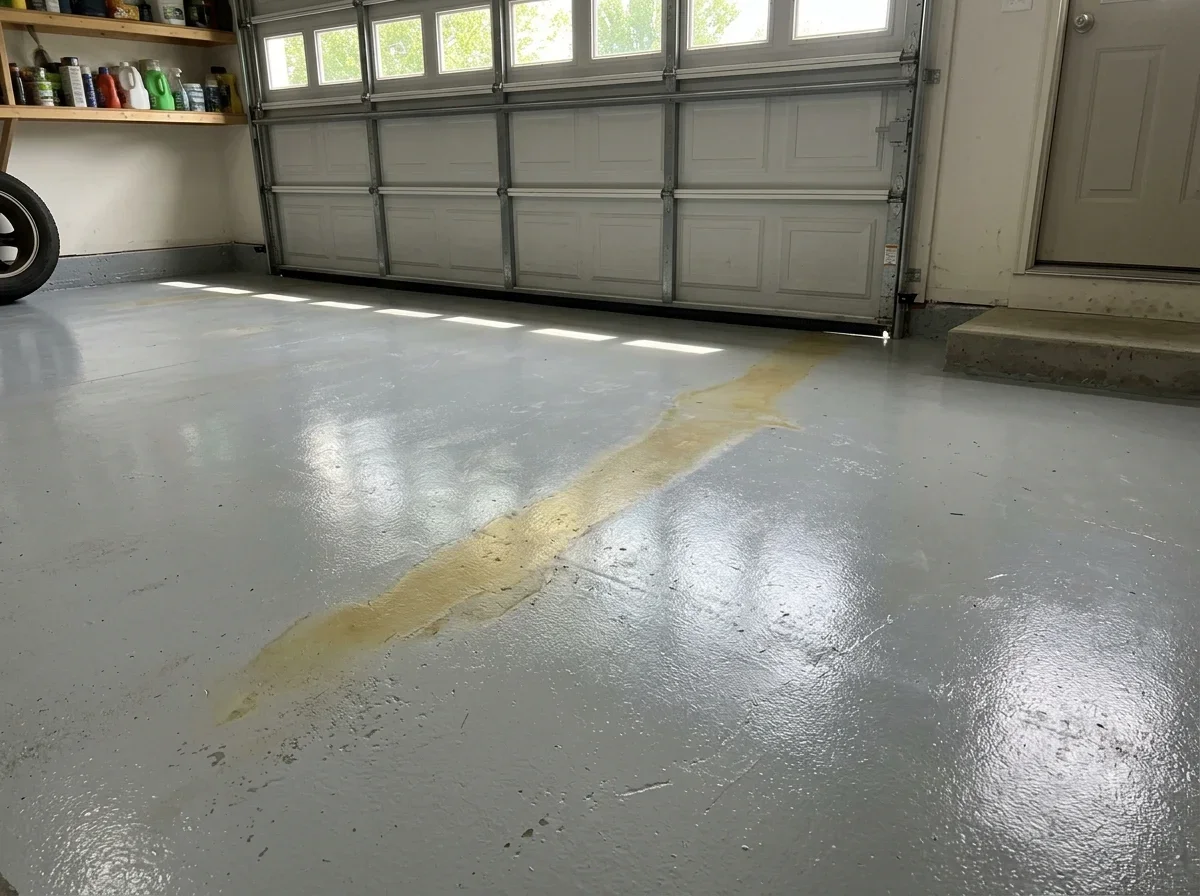
The mechanism is simple. Common epoxy resins contain aromatic (ring-shaped) molecular structures that absorb UV and oxidize, which shows up as ambering.[2] Aliphatic coatings lack those rings, which is why they hold their color.
How it works
How sunlight ambers epoxy
Step 1: UV light reaches the floor
Strongest near the door and windows
Step 2: Aromatic rings in the resin absorb it
Step 3: The resin oxidizes
Chemical change inside the cured coating
Step 4: Amber tint and lower gloss appear
Intensity and duration both matter. More sun and more years mean more degradation, which can appear as yellowing along with reduced gloss.[3] Standard epoxies tend to yellow and lose gloss after extended UV exposure.[4]
You may hear an installer say epoxy only yellows when it's installed badly. That mixes up two separate things.
Good installation prevents bubbling, spotting, and poor adhesion. It does not change the chemistry of a plain epoxy top layer, and that chemistry is what decides whether sunlight ambers it.
Where it shows first
Yellowing starts where the light lands. Expect it nearest the garage door, under any door-panel windows, and along side-door or window glass.
Wisconsin adds a twist. In winter the sun sits low in the sky, so light coming through door windows or under the door can reach much deeper onto the floor than summer sun does. The result is often a streak or stripe of amber rather than an even tint.
Snow on the driveway can bounce extra light inward as well. Treat that as a plausible contributor, not a measured figure.
You can map this yourself. On a clear winter day, watch where the sunlight falls across the slab, then compare that pattern to the discolored areas. If they match, you're looking at UV.
Light colors show it most. Clear coats and white or pale gray floors reveal even mild ambering, while dark colors and decorative flake blends hide it far better.
Not every discoloration is yellowing
Other problems get lumped in with yellowing, and each needs a different response.
| What you see | Likely cause | Direction |
|---|---|---|
| Amber fading from the door inward | UV breakdown of the resin | Topcoat or accept it |
| Round brown or yellow spots | Oil or moisture pushing up from the slab | Fix the moisture source first |
| Yellow film where tires sit | Transfer from hot tires or rubber mats | See hot tire pickup |
| White haze or residue | Road salt left by vehicles | Clean with warm water and a neutral cleaner |
Salt haze is easy to misread in a garage where vehicles park daily through a long cold season. It's a residue sitting on the surface, not a color change in the coating, so it should wipe away.
Uniform yellow over a clear layer on light flake can also come from an over-thick clear coat.
UV-stable topcoats compared with plain epoxy
Epoxy is still a good base layer. The problem is only the top surface, and that's where the fix lives.
UV-stable aliphatic polyurethane finishes are commonly used over epoxy to protect color and appearance.[2] A UV-stabilized aliphatic urethane topcoat can improve UV resistance, according to the Resin Flooring Association.[4] Decorative acrylic or polyurethane topcoats are also recommended where sunlight is a concern.[5]
Here is how the options compare:
- Plain epoxy: Strong bond and build, but it ambers in sunlight. Best in garages with little direct light.
- Aliphatic polyurethane: Holds color and gloss well and adds a tougher, more flexible wear layer over epoxy. Usually applied as a thin finish coat.
- Polyaspartic: Also aliphatic, so it resists UV. It tends to cost more and cure fast, which means a tighter installation window. Our polyaspartic coatings page covers it in more detail.
For choosing a full system, see our guide to the best epoxy for garage floors.
How the parts connect
A sun-ready garage floor system
Concrete slab
Moisture tested first
Epoxy base coat
Strong bond and build
Decorative flake blend
Optional camouflage
UV-stable topcoat
Aliphatic polyurethane or polyaspartic
What you can do about a yellowed floor
The honest answer: yellowing inside cured resin can't be cleaned out. It's a chemical change, not dirt, so polishing or scrubbing won't make it clear again.
Work up this ladder:
- Test a small patch. Clean it with a neutral cleaner and a soft pad. If the tint stays, it isn't dirt.
- Check for other causes. Oil spots, tire film, and salt haze need their own fixes, and slab moisture should be tested before any recoat. Ask your installer which moisture test they use.
- Accept it. If it's mild and cosmetic, leaving it alone is a legitimate choice.
- Abrade and topcoat. Scuff-sand sound epoxy, then apply an aliphatic polyaspartic or polyurethane topcoat. This hides mild yellowing on pigmented or flake floors. On a clear-coated white or light floor, the amber layer stays visible underneath.
- Grind and recoat. If the yellow is in a clear or light base, the coating usually has to be ground off and replaced.
Corrective work can be disruptive and costly because the old coating may need substantial abrasion or removal. Quotes vary, so ask for a written scope that spells out prep and removal.
Our epoxy garage floor cost page helps you weigh repair against recoating.
Timing matters too. Every coating has temperature limits for the slab and air at application, so check the maker's data sheet and plan accordingly.
Before hiring, ask for a written warranty and read whether it excludes UV discoloration.
Pro tip
Ask each installer to quote the same scope, including prep, removal and topcoat type, so the prices compare fairly.
Choosing for a garage with windows
If your garage gets real sun, choose the topcoat first and the color second. A UV-stable finish over an epoxy base, or a polyaspartic system, protects the investment where plain epoxy would amber. Flake blends add camouflage on top of that.
Light control costs far less than a recoat:
- UV-filtering film on door-panel windows
- Frosted or insulated door panels
- A mat or rug as sacrificial cover in the main light stripe
An insulated, windowless door removes the problem at the source.
If you're planning a new floor, our garage floor epoxy page explains what a complete installation involves. Related wear problems, like scratches, are worth planning for at the same time.
Key takeaways
- Plain epoxy ambers because UV oxidizes its aromatic resin
- Yellowing is chemical, so cleaning will not remove it
- An aliphatic topcoat such as polyurethane or polyaspartic protects color
- Light control with film, frosted panels or mats costs less than a recoat
- Check whether a warranty excludes UV discoloration
FAQ
Can yellowed epoxy be fixed?
The yellow itself can't be cleaned or polished out. You can cover it with a UV-stable topcoat on pigmented floors, or grind and recoat if the base is clear or light.
How do you stop epoxy from yellowing?
Use an aliphatic UV-stable topcoat such as polyurethane or polyaspartic, and reduce direct sun with film, frosted panels, or mats.
How long does epoxy last before yellowing?
It depends on UV intensity and exposure duration,[3] so there's no fixed timeline. Sun-exposed spots amber first.
Is the resin still good if it turns yellow?
Usually, yes. The change is generally cosmetic, though severe UV exposure can reduce gloss and, in extreme cases, coating performance.[3] Check for peeling or bubbling to rule out a bigger problem.
Use our free tools to estimate costs and check if your floor is ready for a coating.
Frequently Asked Questions
- American Coatings Association. "UV-Resistant Epoxy Systems." https://www.paint.org/wp-content/uploads/2024/08/UV-Resistance-Epoxy-Systems-CoatingsTech_SeptOct2024.pdf. Accessed October 17, 2026.
- Association for Materials Protection and Performance. "UV Resistant Epoxy?." https://www.highperformancecoatings.org/resources/uv-resistant-epoxy. Accessed October 17, 2026.
- Association for Materials Protection and Performance. "Overcoming UV Degradation in Epoxy Coating Systems." https://www.highperformancecoatings.org/hubfs/Overcoming%20UV%20Degradation%20in%20Epoxy%20Coating%20Systems.pdf. Accessed October 17, 2026.
- Resin Flooring Association. "Epoxy Basics." https://www.resinfloor.org/epoxyschool.com/resources/real-world-epoxies-epoxy-basics.pdf. Accessed October 17, 2026.
- Institute of Corrosion. "Corrosion Protection by Protective Coatings." https://www.icorr.org/14252-2/. Accessed October 17, 2026.