
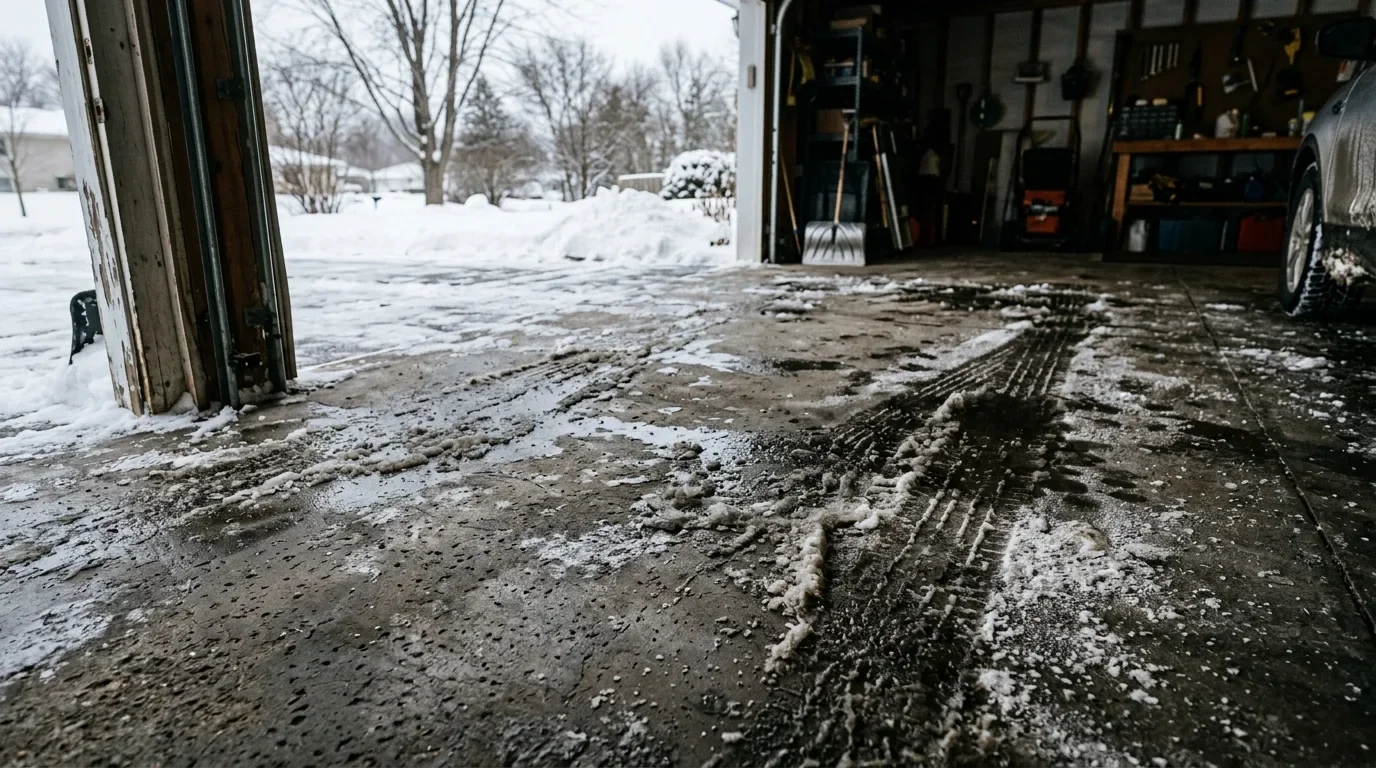
What hot tire pickup is
Hot tire pickup is damage a warm tire does to a coated or sealed concrete floor. The tire leaves marks, soft impressions or bonded rubber, and in worse cases the coating lifts away and sticks to the tread.
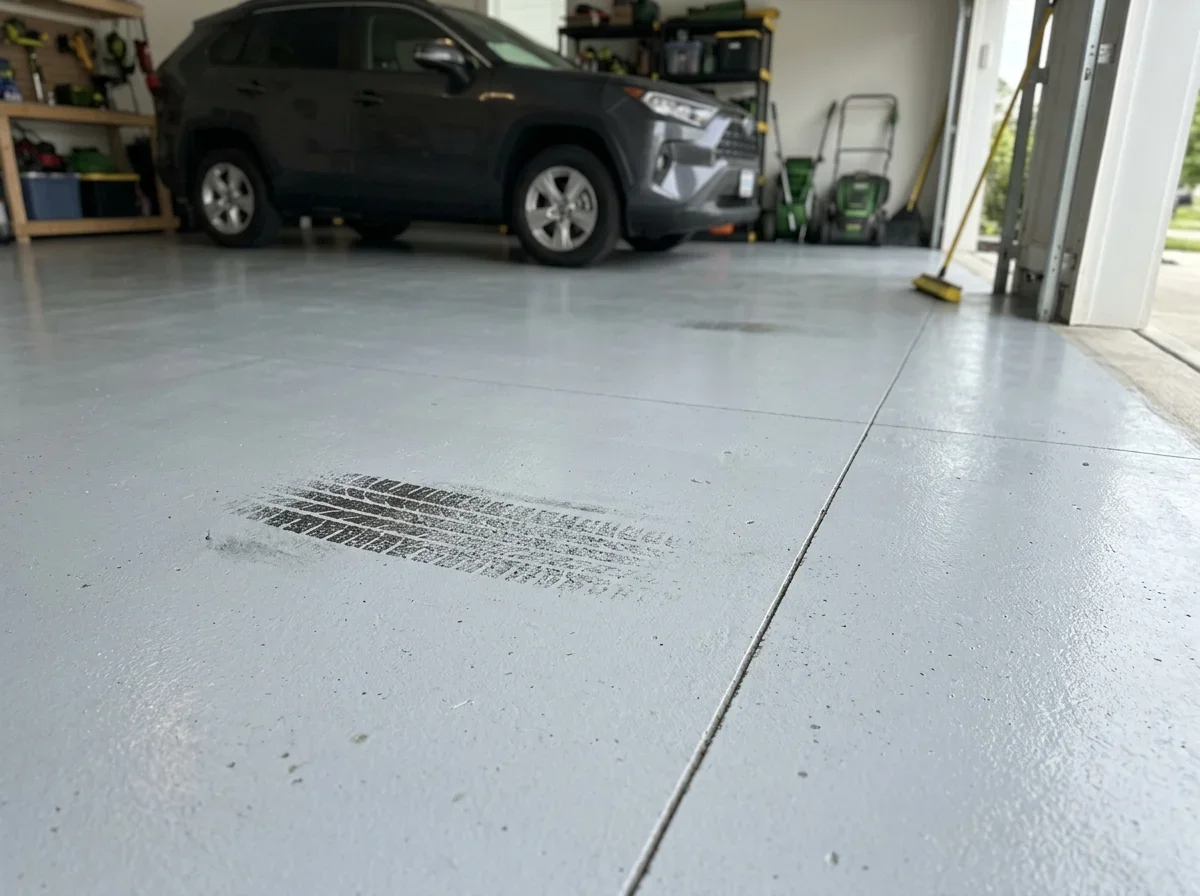
The mechanism is plasticizer migration. When a warm tire presses on a coating, plasticizers in the rubber can move into the film and discolor it.[1] Heat makes those plasticizers more mobile, and the weight of the parked tire pushes them across the contact patch.[4]
Three different outcomes
Not every tire mark is the same problem, and the remedy depends on which one you have.
| What you see | Likely meaning | Typical direction |
|---|---|---|
| Dark or dull tire-shaped ghosting, film intact | Staining or plasticizer transfer | Cleaning test, then possibly a protective clear coat |
| Soft imprint or glossy/dull patch that may partly recover | Surface softening, possibly under-cure | Wait, keep traffic off, ask the installer |
| Lifted film, bubbles, or peeled chips with bare concrete-colored undersides | Delamination, a bond failure | Assessment and repair |
Only an on-site look can confirm what happened. If the film is lifting, the peeling epoxy garage floor guide covers that problem in more detail.
Why a cold floor and warm tires make it worse
In a Wisconsin winter the picture is a cold slab, then a vehicle arriving from a winter commute with warm tread, brakes and undercarriage.
A rapid temperature change at the contact patch is a plausible stress on the film. That is reasoning, not a measured finding, and a cold slab does not by itself cause pickup. A film already weak from low-temperature application or incomplete cure has less margin to handle it.
Winter adds other loads. Cars carry salty slush into the garage, and meltwater can sit under the tires for hours. Rinsing or squeegeeing the floor keeps standing brine off the film.
Cure time and the first drive
"Dry to the touch" and "ready for a car" are two different milestones. A floor can feel hard underfoot while the film is still developing the strength it needs under a heavy, warm tire.
Manufacturers publish separate timings for foot traffic and vehicle traffic. One consumer garage coating data sheet lists vehicle traffic after 7 days of full cure.[2][3] That is one product's schedule, not a universal rule.
Epoxy cure depends on temperature, so a calendar promise means less in a cold garage. Find your product's technical data sheet, read the vehicle-traffic line, and note the temperature it assumes. If the installer's instruction and the data sheet disagree, get the installer's guidance in writing.
Key takeaways
- Dry to the touch is not ready for a car
- Vehicle-traffic timing is listed separately on the data sheet
- One product's data sheet lists 7 days of full cure before vehicle traffic
- Cold garages can slow epoxy cure
Which coating systems resist it
Resistance comes mostly from how tightly the film is crosslinked. According to Euclid Chemical, acrylic and styrene/acrylic sealers are the most susceptible because they have minimal crosslinking. Epoxy and urethane coatings are more crosslinked and less likely to mark, but not immune.[1]
| Family | General reasoning | Cure behavior |
|---|---|---|
| Epoxy (high-solids) | Dense, hard film and strong bond to prepared concrete | Temperature-dependent, can be slow in cold |
| Polyaspartic | Often chosen as a topcoat for chemical and wear resistance | Typically faster, check the data sheet |
| Aliphatic polyurethane | Common protective topcoat over epoxy | Varies by product |
| Polyurea or hybrid | Blends chemistries, performance varies by formula | Varies by product |
Ask for the exact resin and topcoat, not just "epoxy."
For more on choosing, see the guide to the best epoxy for garage floors and the page on polyaspartic coatings.
What to do if marks have started
- Stop parking on the area if the floor is still within its cure window.
- Identify the damage type using the table above: transfer, imprint or lifted film.
- Clean gently. Test a small, hidden spot with a mild compatible cleaner. Solvents can damage or alter some finishes, so get professional guidance before trying one.
- Document everything. Photograph the marks and peeling edges, and note the installation date, garage temperature and when the car first parked.
- Check the warranty and the installer's written cure instructions, then contact the installer in writing.
Tire mats or runners can reduce contact damage during early days, but some rubber products can themselves transfer plasticizers onto a film, so confirm compatibility with the coating manufacturer.
How it works
Steps when marks appear
Step 1: Stop parking on the area
If still within the cure window
Step 2: Identify the damage type
Transfer, imprint or lifted film
Step 3: Clean gently
Test a small hidden spot first
Step 4: Document everything
Photos, install date, garage temperature
Step 5: Check the warranty and contact the installer in writing
Peeling generally needs assessment and repair. Spot repairs can leave color or gloss differences, so ask whether a repair or a full recoat makes more sense. Typical pricing is covered in the epoxy garage floor cost guide.
Pro tip
Photograph the marks the day you notice them and again a week later, so you can show the installer whether they are fading, staying the same or spreading.
Questions for the installer
The best time to ask is before the job.
- What surface preparation method will you use, and what profile will it leave?
- How will moisture in the slab be tested, and what were the results?
- What are the product's minimum and maximum application temperatures?
- Will the garage be heated during application and cure, and to what temperature?
- What does the data sheet say about vehicle traffic and full cure, and at what temperature?
- What is the exact base resin and topcoat chemistry?
- What does the warranty say specifically about hot tire pickup and delamination?
- Can I have the system specification and the cure schedule in writing?
Choosing a garage floor epoxy installer by price alone is where many of these problems begin.
Checklist
Ask before the job
0 of 8 ticked
Tick them off as you go. Nothing is saved or sent.
Frequently asked questions
How do I prevent tire marks on an epoxy floor?
Wait for the full vehicle-traffic cure in the data sheet, make sure the concrete was properly prepared and dry, and ask for a well-specified topcoat. Mats can help during early days if the manufacturer confirms they are compatible.
Can epoxy withstand hot tires?
Often, yes, though not always. Epoxy and urethane coatings are more crosslinked and less likely to mark than acrylic sealers, but they are not immune.[1]
How hot is too hot for epoxy?
No single figure applies to every product. Heat tolerance depends on the formula, so check the manufacturer's data sheet or ask the installer.
How do I repair a chipped epoxy garage floor?
Small chips may be spot-repaired, but the patch can differ in color or gloss from the aged floor. Larger areas of lifted coating usually need an assessment to find the cause before any repair.
Use our free tools to estimate costs and check if your floor is ready for a coating.
Frequently Asked Questions
- Euclid Chemical. "Tire Marking (Hot Tire Pickup) of Concrete Sealers." https://euclidchemical.com/fileshare/Literature/Technical_Bulletins/CP-22-Tire_Marking_Pickup_of_Concrete_Sealers.pdf. Accessed October 17, 2026.
- Rust-Oleum. "EPOXYSHIELD Garage Floor Coating Technical Data Sheet." https://www.rust-oleum.eu/static/datasheet_es_garage_en.pdf. Accessed October 17, 2026.
- Rust-Oleum. "EPOXYSHIELD Garage Floor Coating." https://www.rust-oleum.eu/product/epoxyshield-garage-floor-coating/. Accessed October 17, 2026.
- 239 Exteriors. "Hot Tire Pickup, Defined." https://239exteriors.com/glossary/hot-tire-pickup/. Accessed October 17, 2026.