
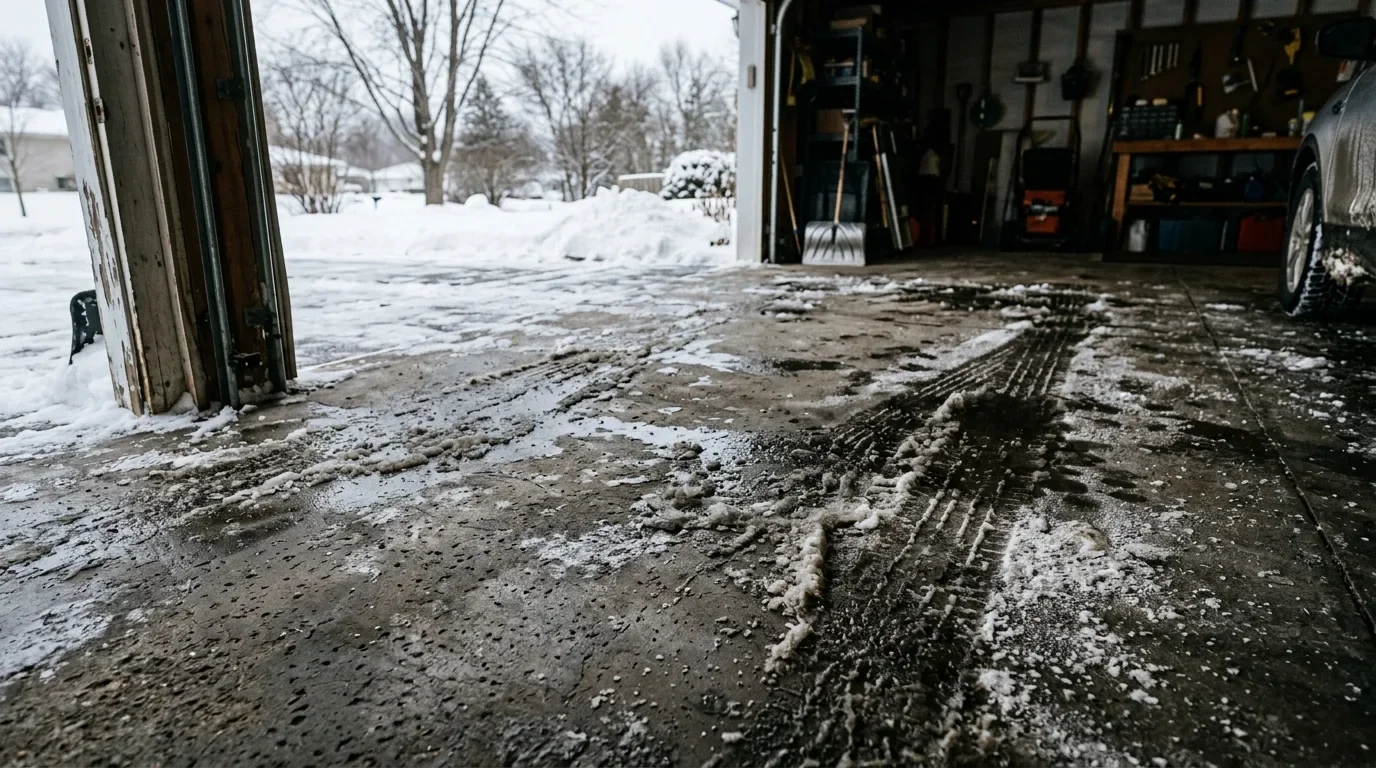
Slab temperature matters more than air temperature
Yes, you can epoxy a garage floor in winter, but only if the slab and air stay within the temperature range printed on that specific product's technical data sheet. The surface also has to stay safely above the dew point, through application and cure.
Miss either condition and the job becomes a gamble.
The limits vary by product. One water-based garage-floor epoxy lists air, material, and surface temperatures of 60 to 85°F.[3] A 100% solids epoxy requires the area to stay between 50 and 100°F during its drying period.[2] An industrial floor system lists 60 to 110°F and prohibits use below 60°F.[5]
Read the sheet for the exact kit you're buying.
Your thermostat measures the air. The coating bonds to the concrete, and a slab sitting on cold ground holds its chill long after the air warms up. A garage can feel fine while the floor is still too cold.
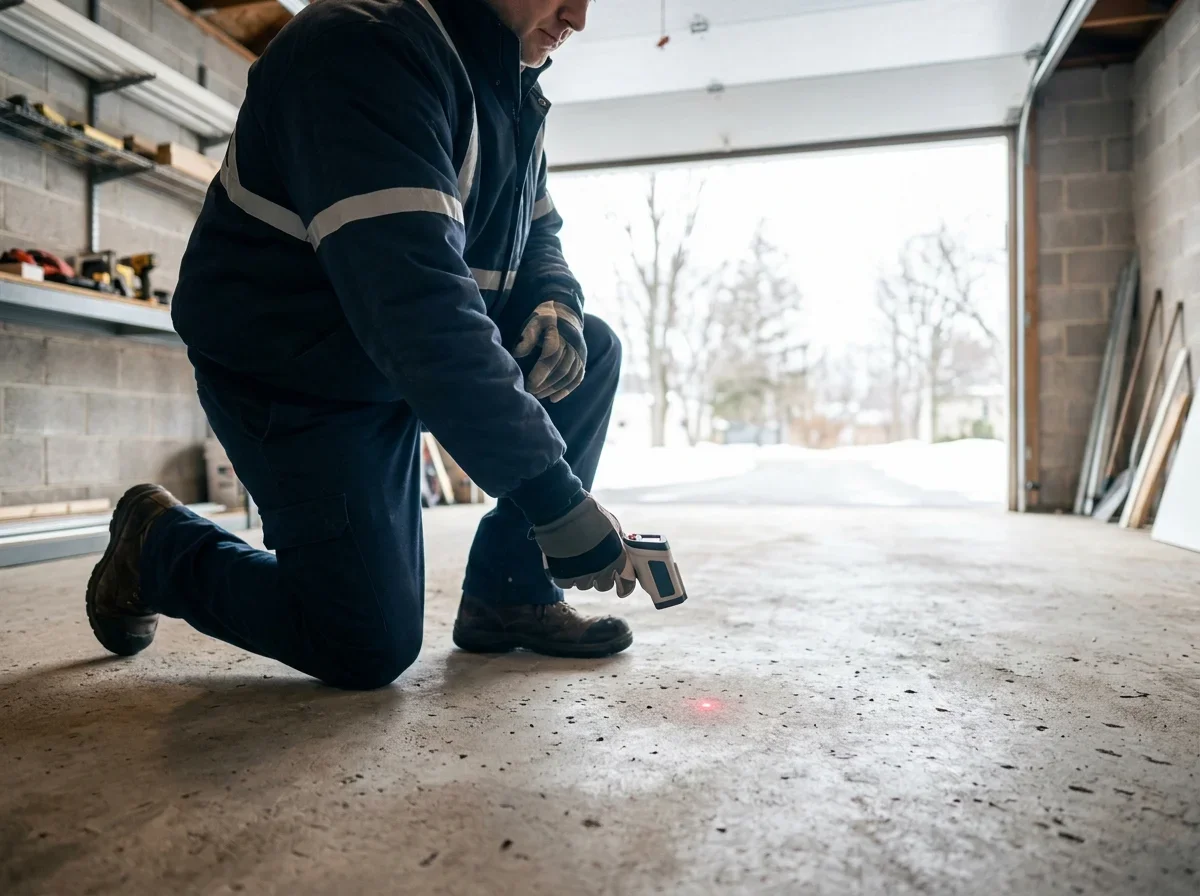
An infrared thermometer is the simplest check. Read the floor in several spots: the apron by the overhead door, the center, and along the house wall.
The coldest reading is the one that counts.
What cold does to cure time and the finished film
Cold slows the chemical reaction that hardens epoxy. One garage-floor data sheet states plainly that dry times increase at cooler temperatures.[3]
A floor that feels firm after a day may only be partly cured underneath.
That matters because "dry to touch," "light foot traffic," "vehicle traffic," and "full cure" are separate milestones, and cold stretches every one of them. A film that looks hard but hasn't fully cured can fail later through peeling, cloudiness, or soft spots under hot tires.
Overnight drops are the sneaky part. If the garage is warm while you work and cools off after you go inside, cure can stall. Low curing temperatures or condensation can also cause amine blush, a waxy surface haze that interferes with the next coat.[6]
Our guide to amine blush on epoxy floors covers how to spot and clean it.
Multi-coat systems add more waiting. Base coat, flakes, and clear coat each need their own cure time, and cold weather can call for extra days between them.
Dew point and surface moisture in a winter garage
Dew point is the temperature at which moisture in the air condenses on a surface. Data sheets typically require the surface to sit at least 5°F above it.[2][3][5] One sheet also warns against applying when condensation or fog is expected before the coating dries.[2]
Winter sets a trap here.
Warm, humid air from a heater, a wet vehicle, or a thaw meets a cold slab, and an invisible film of condensation forms right as the coating goes down. That moisture can cause blush and weak adhesion.[4]
How it works
How winter condensation ruins a coat
Step 1: Warm, humid air meets a cold slab
From a heater, a wet vehicle, or a thaw
Step 2: An invisible film of condensation forms
Step 3: The coating goes down over the moisture
Step 4: Blush and weak adhesion result
Here is an illustrative example, not a real reading. If the garage air and humidity put the dew point at 38°F, a slab at 40°F fails the 5°F margin even though it looks dry. The slab would need to be at least 43°F, and the product's own minimum would still apply on top of that.
A combined air, surface, and humidity meter, plus a dew point calculator, takes the guesswork out. Check the forecast dew point as well as the temperature before you schedule. A warm, wet spell after a hard freeze is when condensation is most likely.
Pro tip
Check the forecast dew point as well as the temperature, and measure the slab itself, not just the air, before you schedule the job.
Heating the space safely for application
Heating only the air often falls short. You need to bring the slab up to temperature well ahead of time and hold it there through the cure window. Pay extra attention near the garage door and exterior walls, which lose heat fastest.
The heater type matters as much as the heat.
Unvented fuel-burning heaters can cause carbon monoxide buildup, a concern Wisconsin's commentary on the Uniform Dwelling Code raises, and one that's sharper in attached garages, which are treated as part of the dwelling.[1] Combustion also adds moisture to the air, which works against your dew point margin. Soot and residue from some heaters can contaminate the surface too.
Epoxy components bring their own fumes, so ventilation requirements on the product label and safety data sheet apply alongside heating. Indirect or electric heat avoids the combustion problem. Keep the resin and hardener indoors until use so the material isn't starting cold, and make sure a working CO alarm covers the living space next to the garage.
Sealing gaps around the door helps hold heat, but never at the cost of trapping exhaust inside.
Fast-cure systems and their limits
Some coatings are built for colder conditions. One epoxy mastic with a low-temperature activator allows application at 40 to 60°F, but only if the temperature won't drop below 40°F during the first 24 hours.[6]
That condition is the catch. The limit applies to the cure, not just the moment you roll it out.
Polyaspartic and polyurea systems are often marketed for cold weather. Compare each product's own data sheet rather than relying on category claims, and ask about working time, since faster cure typically leaves less room for error during application. Companies selling these systems have a commercial interest in the comparison, so weigh their claims accordingly.
No coating rescues a poorly prepared slab.
Grinding, oil removal, and thorough vacuuming still decide whether the floor sticks. If you're weighing options, see our guide to the best epoxy for garage floors and the page on polyaspartic coatings.
When waiting for spring is the better call
Waiting costs you a few months of a nicer floor. A failed coating costs you the grinding, the redo, and the original materials.
If you want a sense of what a redo adds, our epoxy garage floor cost page is a good starting point.
Waiting is the safer call if any of these apply:
- The slab can't be held in the data sheet's range for the full cure window.
- Only unvented fuel heaters are available.
- The forecast shows a cold snap or thaw during cure.
- The slab is damp, or salt residue from winter driving can't be fully cleaned off.
If you do go ahead, a professional garage floor epoxy installer should answer these questions clearly:
- What are the published minimum slab and air temperatures for this product, and will you measure and record them?
- How will the space be heated, with what type of heater, and for how long after application?
- How do you check the slab for moisture and salt before coating?
- What is the cure schedule before vehicles can return?
- What does the warranty say about application temperature?
- Can I see the data sheet for the exact products?
- What happens if the film doesn't cure?
Vague answers on temperature are a signal to wait.
Checklist
Questions to ask an installer
0 of 7 ticked
Tick them off as you go. Nothing is saved or sent.
Use our free tools to estimate costs and check if your floor is ready for a coating.
Frequently Asked Questions
- Wisconsin Department of Safety and Professional Services. "SPS 323 Commentary." https://dsps.wi.gov/MediaFileLocation/45abu3wd/sps-323-commentary.pdf. Accessed October 17, 2026.
- Benjamin Moore. "100% Solids Epoxy Floor Coating V430 Technical Data Sheet." https://media.benjaminmoore.com/WebServices/prod/assets/stage/datasheets/TDS_V430/20180803%20Corotech%20V430_%20TDS%20EN.pdf. Accessed October 17, 2026.
- Rust-Oleum. "EpoxyShield Water-Based Epoxy Garage Floor Coating Technical Data Sheet." https://www.rustoleum.com/~/media/DigitalEncyclopedia/Documents/RustoleumUSA/TDS/English/CBG/EpoxyShield/ESH-39_EpoxyShield_Water-based_Epoxy_Garage_Floor_Coating_Pouch_Kits_TDS.ashx. Accessed October 17, 2026.
- Sherwin-Williams. "How to Identify, Prevent & Remove Amine Blush in Epoxy." https://industrial.sherwin-williams.com/na/us/en/resin-flooring/contractor-center/technical-articles/amine-blush-reaction-epoxy-coatings.html. Accessed October 17, 2026.
- PPG. "KL5500/KL5500B Technical Data Sheet." https://max.ppg.com/adaptivemedia/rendition?id=c1ff980d50ea559d99c75832592cbd555001f868. Accessed October 17, 2026.
- Rust-Oleum. "ROCEPOXY Direct to Metal Epoxy Mastic 9100 Technical Data Sheet." https://www.rustoleum.com/-/media/9797D3B793404EF88DBEF2EF21FD901F.ashx. Accessed October 17, 2026.