
Why a smooth coating gets slick
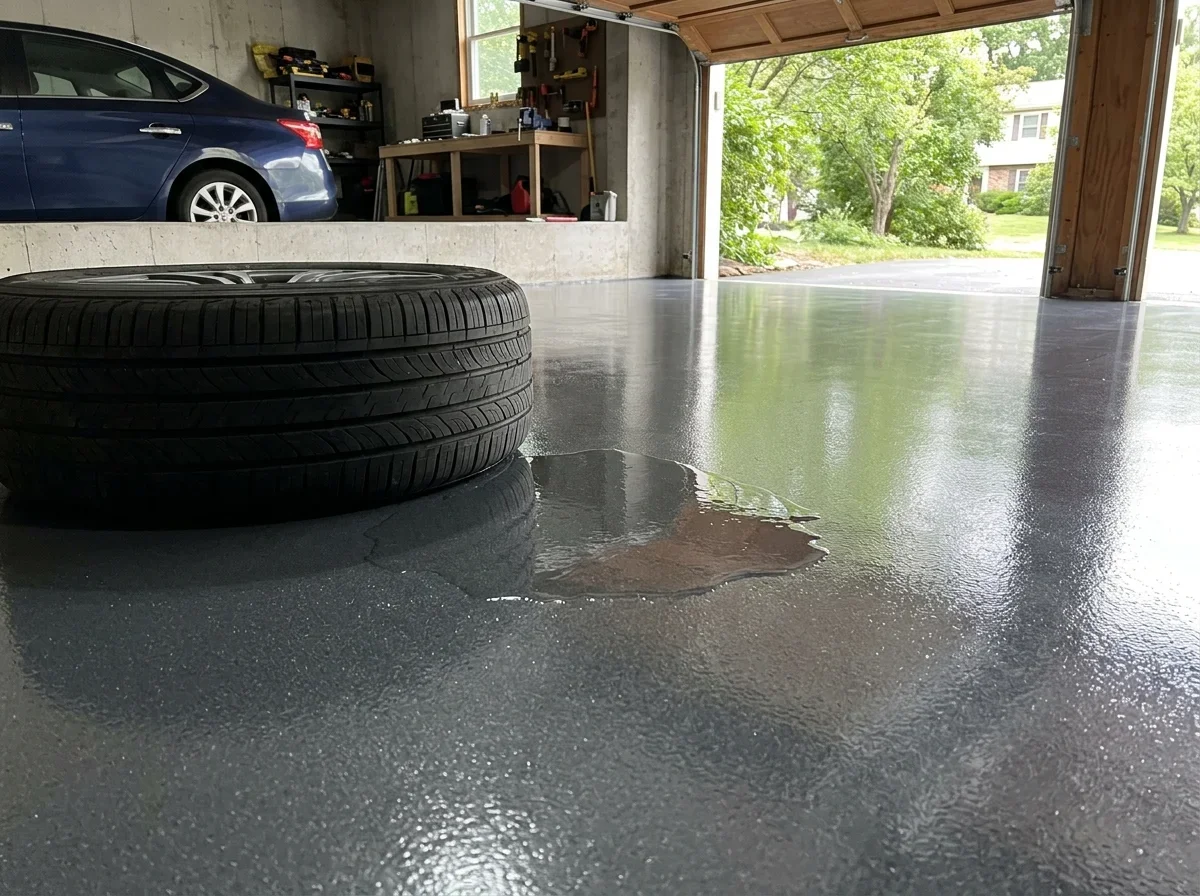
A cured epoxy film is smooth and non-absorbent. Water has nowhere to go, so it spreads across the top as a continuous film instead of soaking in. A boot sole then rides on that film rather than gripping the surface.
That's why the debate over whether epoxy is "inherently slippery" misses the point. Both sides are partly right.
The film is smooth, so grip depends on the finish, any additive in the coating, and what's on the surface: water, oil, salt slurry or fine dust. One coating-maker FAQ notes that smooth epoxy can be slippery when wet and points to aluminum oxide, polymer beads or textured aggregate broadcasts as the fixes.[4]
Gloss makes it worse.
A high-gloss finish usually feels slicker than a satin or matte one. A shiny floor can also hide how little traction it has until someone steps on it wet.
Wet boots, slush and winter traffic
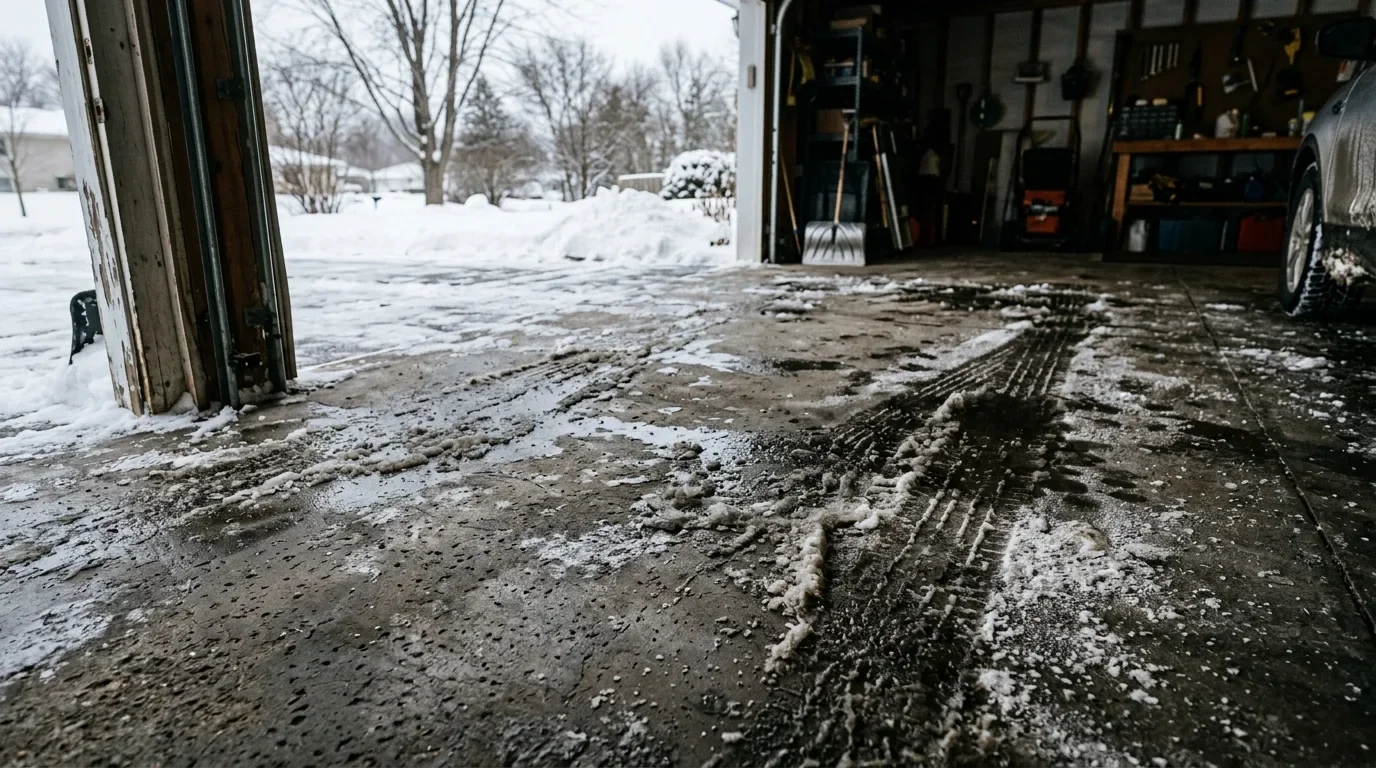
Picture the usual Wisconsin sequence. A vehicle rolls in with packed slush and salty brine in the wheel wells, the snow melts, and a puddle forms around the tire footprint. Then you step out of the car onto exactly that spot.
In a garage that stays cold, meltwater can freeze into a thin film, and ice on a glossy floor is worse than water alone.
Salt adds a second problem. Brine dries to a white residue that dulls traction and shows up on the floor. Our guide to road salt and slush on epoxy garage floors covers that side in more detail.
Standing water is the worst case for any coating, and in winter a garage often has some.
Drainage helps. A slope toward a floor drain or the garage door leaves less slush and salty water sitting on the surface.
Flake, grit and texture options
You have a few ways to break up that water film and give soles something to grip. Each one changes how the floor looks and cleans.
Decorative flake
Flake adds some texture, and coating makers note that flake systems can be made slip-resistant with textured flakes or anti-slip additives, including finishes meant for wet conditions.[1] Flake alone is not a guarantee, though.
A sparse broadcast, or flakes buried under a thick clear coat, can still feel slick. A fuller broadcast is better, and a flake epoxy floor with an anti-slip topcoat is the usual combination for a good-looking, safer result.
Aluminum oxide and polymer grit
Aluminum oxide is marketed for tough, durable skid resistance and for use with two-part floor coatings.[3] Polymer beads add skid resistance with less visual change and are easier to clean than more aggressive textures.[2]
Coarser products give a stronger texture profile, while finer ones are easier to keep clean.[5]
Matte or satin topcoats
A lower-sheen finish won't add much traction by itself, but it removes the glass-like look and pairs well with an additive. The same principles apply to polyaspartic topcoats.
Choose a textured or matte finish, and get the additive type and amount from that product's data sheet.
Pro tip
Ask for a small test area with different grit levels, then check it wet before committing the whole floor.
Trade-offs in cleaning and appearance
More texture means more grip, and it also means more places for dirt to settle. A smooth floor is easy to sweep, mop and squeegee. A rougher one holds grime and takes more effort to clean.
Salt makes this more noticeable. Brine residue shows on dark or textured surfaces, and it's harder to rinse out of the texture than off a smooth film.
Very coarse aggregate has other downsides. It can feel rough underfoot and make a floor jack or caster wheels harder to move.
For most garages, a fine to moderate texture is the practical middle ground. Ask for a test area with different grit levels so you can judge winter traction against cleaning effort before committing the whole floor.
Adding traction to an existing floor
A slippery floor you already have can usually be improved, but the right path depends on the coating's condition and compatibility. Have an installer confirm before you buy anything.
- Clean and degrease first. Oil, wax-based cleaners and tire residue can make a floor slicker than the coating itself.
- Check the coating. If it's sound and well bonded, it's a candidate for recoating. If it's peeling or failing, grit on top won't fix it.
- Scuff or grind. Painting over a glossy cured film without abrading it can fail to bond, so mechanical preparation matters.
- Apply a compatible textured topcoat. The grit should be mixed or broadcast into the wet coat and kept evenly distributed, not sprinkled on casually at the end.
Grit can settle in the bucket, so it needs regular remixing during application to avoid uneven traction. For help weighing recoating against a full redo, see the epoxy garage floor cost guide.
How it works
Adding traction to an existing floor
Step 1: Clean and degrease
Remove oil, wax-based cleaners and tire residue
Step 2: Check the coating
Sound and bonded means it can be recoated
Step 3: Scuff or grind
Abrade the glossy cured film so the topcoat bonds
Step 4: Apply a compatible textured topcoat
Grit mixed or broadcast into the wet coat
Mats are a reasonable stopgap. Put absorbent ones where you first step in, and keep a squeegee near the entry to clear slush quickly.
Treat mats as a supplement, not a replacement for traction in the coating.
Asking for traction in the quote
Slip-resistance is easy to promise and hard to compare, so get the details in writing. Zone the texture if you want to control cost and cleaning: the driver-door exit, the path to the house entry and the garage-door threshold matter most.
Questions worth asking any installer of a garage floor epoxy system:
- Which additive is used: aluminum oxide, polymer grit or flake?
- Is it mixed into the topcoat or broadcast into it?
- What finish is the topcoat: gloss, satin or matte?
- Is coverage full-floor or zoned to high-risk areas?
- How should the textured surface be cleaned, especially after salt season?
- Does the maker's data sheet name a slip-resistance test?
That last question matters because "slip-resistant" claims vary by product. No friction number applies unless the manufacturer publishes it, so ask to see the data sheet.
Also ask for a written scope that names the additive and finish, and for proof of general liability insurance. If you're still choosing a system, our guide to the best epoxy for garage floors is a good place to start.
Checklist
Put in the written quote
0 of 6 ticked
Tick them off as you go. Nothing is saved or sent.
If you're also dealing with surface wear, the page on scratches on an epoxy garage floor covers surface wear.
Quick answers
Is epoxy garage flooring slippery?
A smooth, glossy epoxy film can be slippery when wet. Grip depends on the finish, any additive and what is on the surface.
How do I make an epoxy garage floor less slippery?
Add aluminum oxide, polymer grit or textured flake in a compatible topcoat, and consider a satin or matte finish.
Does flake make epoxy slip-resistant?
Not by itself. A sparse broadcast or flakes under a thick clear coat can still feel slick, so pair flake with an anti-slip topcoat.
Does a textured floor hide road salt?
Often it does the opposite. Brine residue shows on textured surfaces and is harder to rinse out of the texture.
Are floor mats enough?
Mats are a reasonable stopgap near the entry, but they supplement traction in the coating rather than replace it.
Use our free tools to estimate costs and check if your floor is ready for a coating.
Frequently Asked Questions
- Sherwin-Williams. "Epoxy Flake Floors." https://industrial.sherwin-williams.com/na/us/en/resin-flooring/resources/systems-chemistry/flake-flooring.html. Accessed October 17, 2026.
- Exterior Performance Coatings. "Polybead Anti-Slip Additive." https://exteriorcoatings.com/category/tools-supplies-etc/. Accessed October 17, 2026.
- Exterior Performance Coatings. "Aluminum Oxide Anti-Slip." https://exteriorcoatings.com/category/tools-supplies-etc/. Accessed October 17, 2026.
- Epoxy Creations. "Epoxy Flooring FAQ." https://www.epoxycreations.net/faq. Accessed October 17, 2026.
- Exterior Performance Coatings. "Tools, Supplies, Etc.." https://exteriorcoatings.com/category/tools-supplies-etc/. Accessed October 17, 2026.