
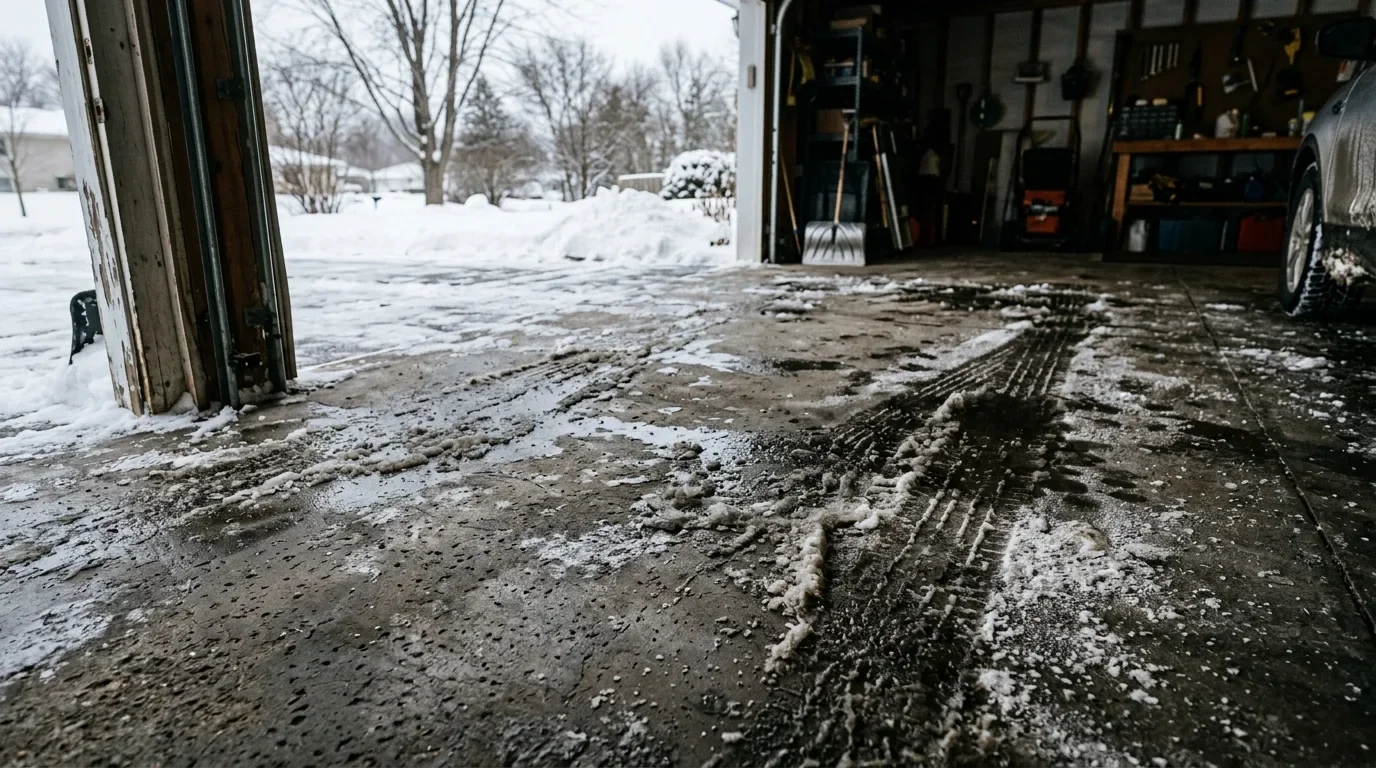
How salt and slush end up on a garage floor
Wisconsin leans hard on chloride to keep roads passable. The Department of Transportation uses chloride products for anti-icing and de-icing because they lower the freezing point of snow and ice. Salt works best once pavement temperatures are about 15 to 20°F or higher.[1]
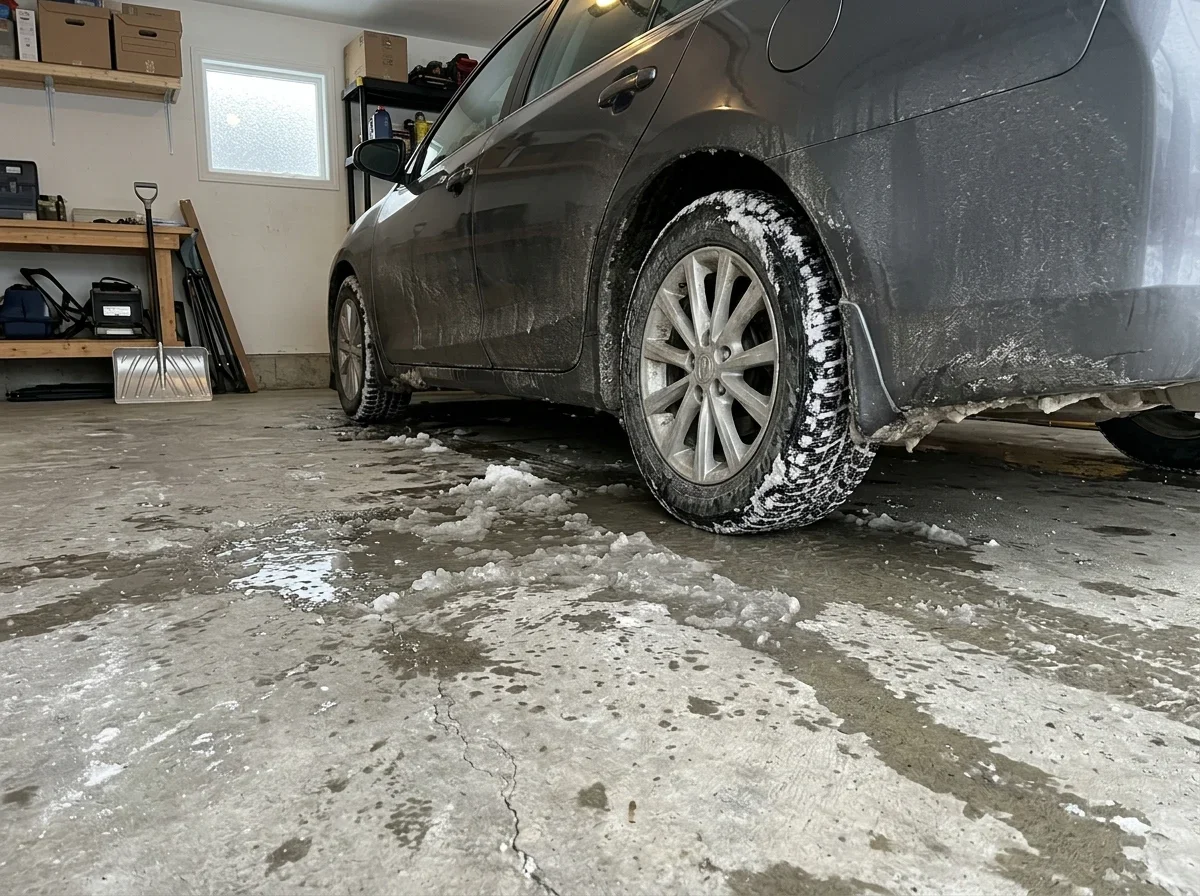
That salt does not stay on the highway. The DNR notes that winters here rely on salt applied to roads, parking lots and sidewalks, so chloride-laden snow and meltwater are a recurring presence everywhere you drive.[2]
Your vehicle collects it all.
Packed slush clings to wheel wells, bumpers and undercarriage, and a warm garage turns it into brine within hours. Boots add their share at the door. The result is a pool of salty water, often with sand in it, sitting on the slab until it dries or you move it.
What salt does to bare concrete
Bare concrete is porous. Brine soaks into the surface pores, and each time the garage cools and the water freezes, it expands inside the slab. Repeated cycles can push off the top layer in flakes or small craters, a problem called scaling or spalling.
Salt adds a second issue. As brine dries, it leaves crystals and a pale residue on the surface. Areas where water sits longest tend to roughen first.
Low spots near the garage door and the tire tracks are the usual trouble areas.
A heated garage does not cancel this out. Warmth melts snow and dissolves salt faster, which can leave more liquid on the floor unless you push it out. Heat also means the slab may go through wet and dry cycles all season rather than staying frozen.
If your floor already shows flaking or pitting, read about spalling and flaking concrete before deciding on any coating. White powder on the surface is a separate matter, covered in efflorescence on garage floors.
What a coating protects and where it still fails
A sealed film changes the way meltwater meets the slab. Instead of soaking into pores, brine sits on top of the coating, where you can sweep or squeegee it away. Salt stains wipe off more easily, and the concrete surface is shielded from direct soaking.
How it works
How a coating handles brine
Step 1: Brine lands on the floor
Meltwater drips from the vehicle
Step 2: Sealed film keeps it on the surface
It does not soak into pores
Step 3: Sweep or squeegee it away
Stains wipe off more easily
That is the real benefit, and it is a good one.
It is not a force field, though. Moisture can still enter through cracks, control joints and the perimeter edges where the coating stops. Water can also reach the slab from below, which a surface film cannot control.
Preparation decides the outcome
A coating is only as sound as the concrete under it. Epoxy over weak, oily or flaking concrete can lift, crack or peel along with the surface beneath it.
Proper work means mechanically preparing the whole slab, typically by grinding or shotblasting, and repairing damage first. You can see what that involves on the floor prep and repair page.
Ask any installer how the system handles joints, cracks and edges, because those are the places winter finds first. For coating chemistry and options, the guide to the best epoxy for garage floors covers the choices. The garage floor epoxy page describes the installed system.
A coating also does nothing for your vehicle. Road salt still attacks the underside of the car whether the floor is coated or not.
Cleaning routine for salt season
The habit that matters most is simple: do not let brine sit.
Squeegee standing meltwater toward the garage door drain-off area, and sweep up salt chunks and sand before they dry and get ground into the floor. Dried salt and sand are abrasive, even on a coated surface.
Pro tip
Keep a broom and squeegee within reach of the door you use most, so clearing brine takes seconds and actually gets done.
A few small steps reduce the load:
- Knock packed snow and slush out of the wheel wells before you pull in, when it is practical.
- Use a containment or absorbent mat under the vehicle, and lift and dry it now and then so moisture does not get trapped beneath.
- Keep a broom, squeegee and a boot tray by the entry door.
When temperatures allow, rinse the floor and squeegee the water out. A more thorough wash in spring removes the salt and sand that built up over the season.
Pressure washing and cleaning products
Pressure washing a coated floor raises a fair question. Plenty of coating makers address it in their care instructions, so check your installer's guidance or the product data sheet before you reach for the wand.
Harsh pressure aimed at edges, cracks or any lifting spot can work water under the film.
The same advice covers cleaners. Rather than guessing what to avoid, follow the care sheet for your specific system. Mild cleaning with a soft brush or mop is generally the safer starting point, and the manufacturer's list of products to avoid settles the rest.
How long a coated floor lasts depends on preparation, the system installed and how well you keep up with winter cleanup. Ask your installer what the warranty covers and what it excludes.
Wet traction and standing water
A smooth, glossy coating looks great in a showroom photo and can be slick when wet. Salty meltwater on a plain film makes that worse, especially at the door where you step out of the car.
Texture solves most of it.
Broadcast flakes, quartz or another traction additive give the surface grip without making it hard to clean. When you request a quote, ask specifically what slip-resistance the system includes rather than assuming "epoxy" covers it.
Standing water is the other half. Puddles hide in low spots, and they freeze if the garage cools. Squeegeeing regularly keeps water from pooling and keeps the floor safer underfoot.
When winter damage means a floor needs repair first
Some signs say the floor needs work before any coating goes down. Look for these:
- Flaking, scaling or a crumbly surface that comes off under a broom
- Pits and rough patches, especially where brine sat all winter
- Cracks or joints that have opened or broken at the edges
- Old coating that is peeling or lifting in sheets
Covering these problems hides them for a while and invites failure.
Checklist
Signs the floor needs repair before coating
0 of 4 ticked
Tick them off as you go. Nothing is saved or sent.
Surface repair and proper preparation come first, and that is why quotes vary: the amount of repair work changes the job. For a sense of how repair and coating costs fit together, see the epoxy garage floor cost guide.
A good installer will walk the slab with you, point out weak spots and explain what needs fixing. Be wary of anyone who skips that conversation.
Quick answers
Does road salt damage bare garage concrete?
Yes. Brine soaks into the pores, and repeated freezing can push off the top layer in flakes or small craters.
Does a coating make the floor immune to salt?
No. It keeps brine on the surface so you can clear it, but moisture can still enter through cracks, joints and edges.
Can I pressure wash a coated floor?
Check your installer's guidance or the product data sheet first. Harsh pressure at edges or cracks can work water under the film.
Should I repair the floor before coating it?
Yes. Flaking, pitting, open cracks or peeling old coating should be repaired and the slab properly prepared first.
Use our free tools to estimate costs and check if your floor is ready for a coating.
Frequently Asked Questions
- Wisconsin Department of Transportation. "Winter maintenance frequently asked questions." https://wisconsindot.gov/Pages/doing-bus/local-gov/hwy-mnt/winter-maintenance/faq.aspx. Accessed October 17, 2026.
- Wisconsin Department of Natural Resources. "Salt and storm water." https://dnr.wisconsin.gov/topic/Stormwater/learn_more/salt.html. Accessed October 17, 2026.