
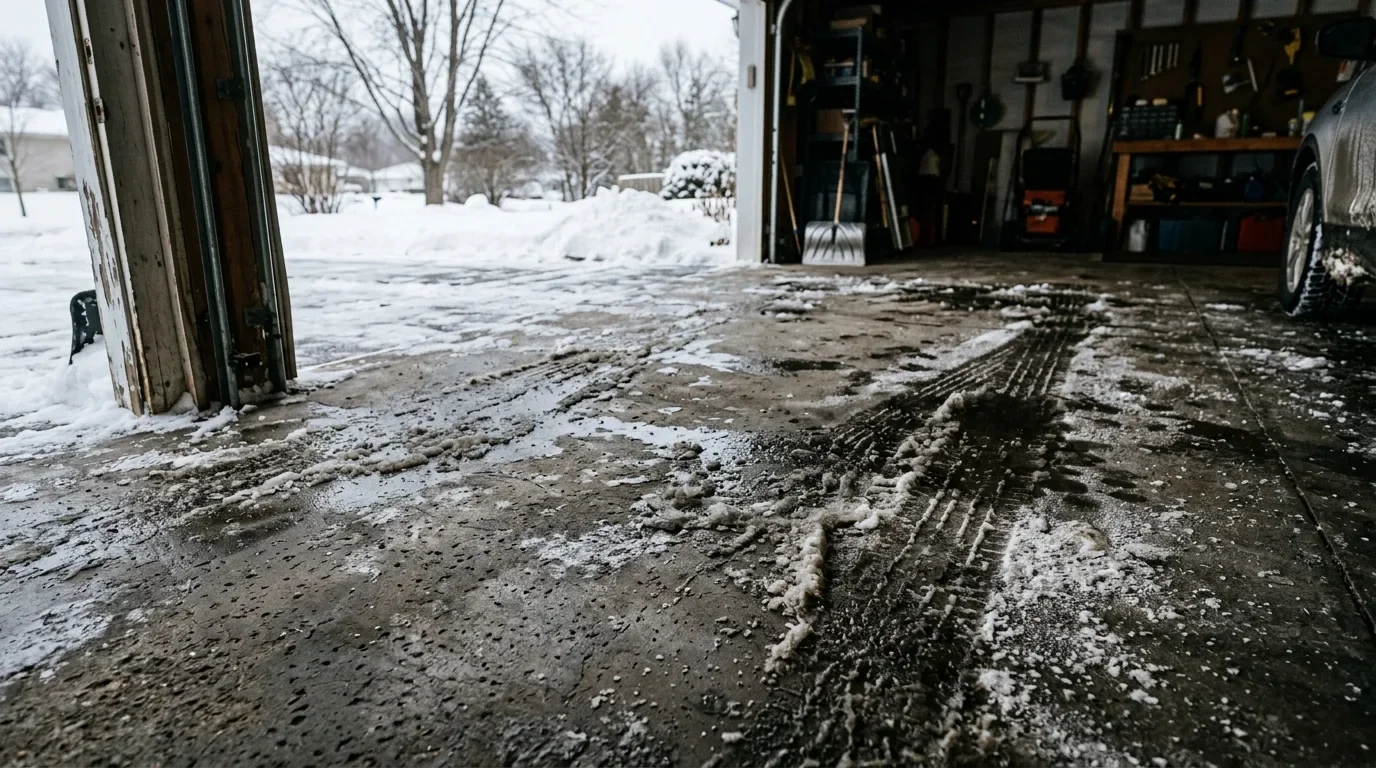
Scaling, spalling and dusting are not the same
Scaling is flaking or peeling of the surface mortar, caused by freeze-thaw exposure.[5] Spalling is deeper, with larger pieces breaking away from the slab. Dusting is a fine powder that rubs off a weak surface layer.
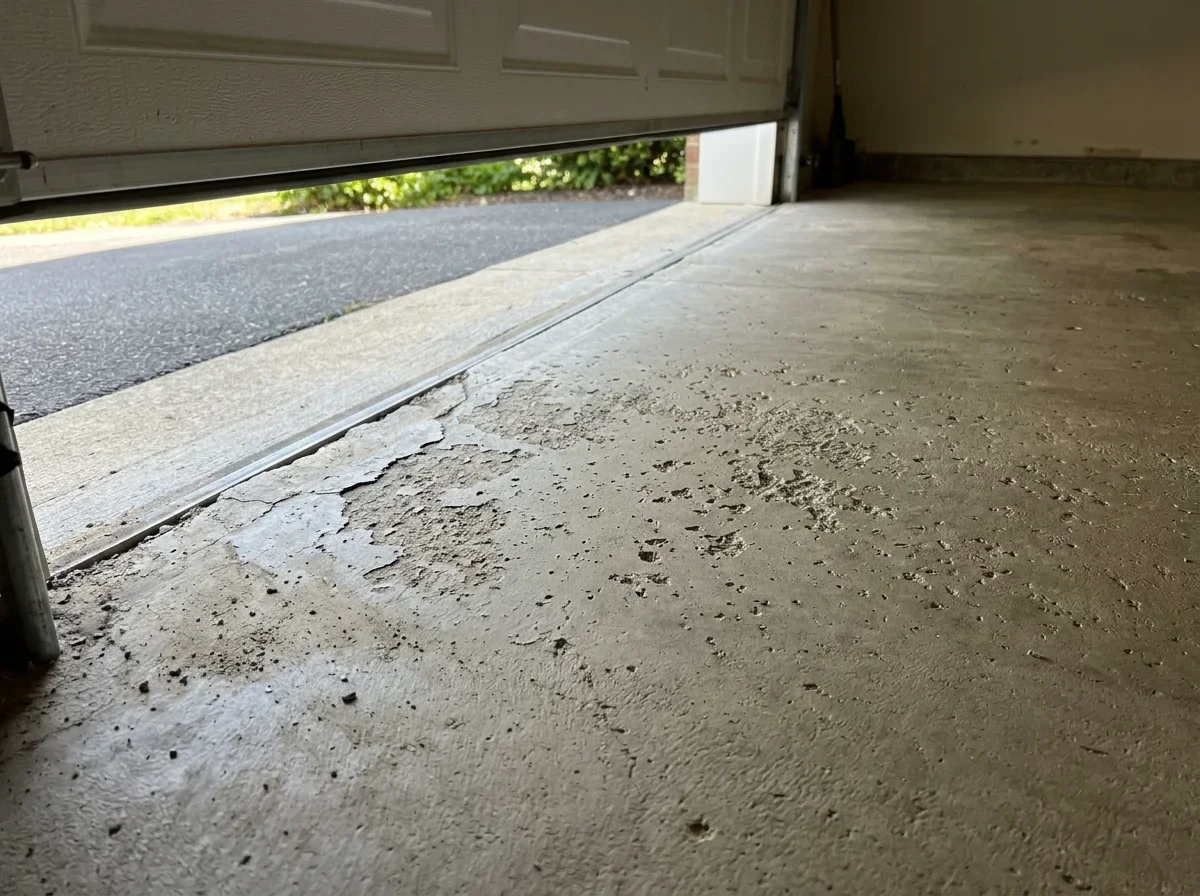
| Damage | What it looks like | Typical cause | Can it be coated? |
|---|---|---|---|
| Scaling | Thin flakes peeling, rough pitted surface | Freeze-thaw cycling, deicer on a saturated surface | Only after repair or resurfacing |
| Spalling | Chunks or deeper pieces missing, often at joints and cracks | Deeper freeze-thaw damage, moisture, corroding steel | Not until repaired to sound concrete |
| Dusting | Powder that rubs off on a palm or dark cloth | Weak surface layer (laitance) | Not until the weak layer is ground off or hardened |
The distinction matters because PCA guidance says dusting can sometimes be corrected by grinding away the weak laitance or applying a surface hardener. Scaling can generally be handled with a thin bonded overlay or grinding if sound, air-entrained concrete remains below.[4]
Freeze-thaw and deicing salts do the damage
WisDOT defines freeze-thaw damage as progressive deterioration of saturated concrete exposed to repeated freezing and thawing. It describes scaling as one form of that damage, marked by crumbling at the exterior.[1]
Water has to be present. Dry concrete doesn't scale.
Garage slabs get wet in a way people don't expect. A truck rolls in carrying slush, and the slush melts and pools on the floor. Research from Wisconsin names pooled water containing deicer as a key condition.[3]
Why an interior slab still suffers
An unheated garage in a Wisconsin winter can swing through freezing and thawing much as a driveway does. The tire tracks and the low spot near the door are where salty meltwater sits longest, which is why damage usually starts there.
Concrete Alberta also warns against deicing salts on new concrete. A young slab is the most vulnerable.[5]
How bad is it
You can sort most slabs into three groups with a screwdriver, a hammer and a few minutes.
- Light flaking: The surface is rough or pitted, but a screwdriver tip doesn't dig in more than a shallow scrape. Grinding or a thin bonded overlay is the usual route.[4]
- Patches: Distinct pits or broken areas with sound concrete around them. These need cutting back and patching, then grinding flush.
- Deep spalls: Aggregate is exposed, chunks come loose, or the surface keeps crumbling. Treat this as a concrete repair job first and a coating project second.
Rub your palm or a dark cloth across the floor to check for dusting. Tap the slab with a hammer and listen for a hollow sound, which suggests the top layer has separated.
How serious is it
Level 1 of 3: Light flaking
Signs Rough or pitted surface, screwdriver makes only a shallow scrape
What to do Grinding or a thin bonded overlay
Level 2 of 3: Patches
Signs Distinct pits or broken areas with sound concrete around them
What to do Cut back and patch, then grind flush
Level 3 of 3: Deep spalls
Signs Aggregate exposed, chunks loose, surface keeps crumbling
What to do Concrete repair first, coating second
You can also run our floor risk assessment to check whether the slab is ready for coating.
Repair and resurfacing options
Matching the product to the damage matters more than the brand.
- Grinding or a surface hardener suits dusting and weak surface paste.[4]
- Thin bonded overlays or grinding suit widespread scaling over sound concrete.[4]
- Patch materials suit localized spalls. Check the manufacturer's data sheet for depth limits, temperature range and cure time before you buy.
Whatever the material, the sequence is consistent. Remove all weak or unsound material, then clean off dirt, oil, paint and dust before anything new goes on.[5] Caltrans repair guidance likewise requires removing unsound concrete and cleaning the exposed surface before replacement material is installed.[6]
How it works
The repair sequence
Step 1: Remove weak or unsound material
Step 2: Clean off dirt, oil, paint and dust
Step 3: Patch or resurface with a compatible product
Step 4: Grind patches flush
Patches are often visible and slightly uneven. Grinding them flush helps.
Pro tip
Check the manufacturer's data sheet for depth limits, temperature range and cure time before you buy a patch material.
If you'd rather not have a patchwork look at all, concrete polishing is a finishing alternative once the slab is sound.
Cost depends on how much area is damaged, how deep, and whether grinding or an overlay is needed. Quotes vary, so ask what each one includes.
Why coatings need sound concrete
An epoxy or similar coating is only as strong as the concrete it grips. If the top layer is chalky, flaking or loose, the coating bonds to that weak skin rather than to solid slab.
Eventually the skin lets go and takes the coating with it.
Decorative flakes can disguise small divots, but they don't repair anything. Washing the floor isn't enough either. The weak layer has to be mechanically removed, which is why proper prep often means diamond grinding, removing loose material and filling pits.[4][5]
Moisture is the other threat. Water from melting snow, poor drainage or the slab itself can keep a coating from bonding. Check gutters, grading and standing water, and ask any installer how they test the slab.
Checklist
Before coating the slab
0 of 5 ticked
Tick them off as you go. Nothing is saved or sent.
Professional floor prep and repair covers grinding, patching and flush finishing before any coating goes down. Once the slab is ready, our guide to the best epoxy for garage floors helps with product choice. If salty slush is your main worry, see road salt and slush on epoxy garage floors.
When replacement is the honest answer
Some slabs aren't worth patching. Replacement deserves a serious look if:
- spalling covers most of the slab
- earlier repairs have failed repeatedly
- the slab is moving, settling or has cracks with one side higher than the other
- the surface keeps crumbling after you've removed the loose material
A coating can't correct movement in the slab, so cracks that shift will telegraph through any finish. If you suspect settlement or structural cracking, have a structural engineer or qualified contractor evaluate it before spending on surface work. For cracking questions, see epoxy over cracked concrete.
Replacement means demolition, hauling and a cure period when the garage is out of use. If the concrete is sound underneath, grinding, patching and then polishing or coating is usually far less invasive.
Keeping it from coming back
Once the slab is repaired, limit what caused the damage. Rinse or squeegee salty slush toward the door instead of letting it sit, and fix drainage problems.
WisDOT research found that a topical silane sealer significantly improved freeze-thaw performance in the tested mixtures, so a sealer on sound concrete is worth asking about.[2]
Quick answers
Is concrete spalling serious?
It depends on depth and spread. Light surface flaking is mostly cosmetic, but loose chunks, exposed aggregate or continued crumbling mean the slab needs repair.
Can spalling be fixed?
Yes, when sound concrete remains underneath. Remove all weak material, clean the surface, then patch or resurface with a compatible product.
How can I resurface spalled concrete?
Grind or otherwise mechanically remove the weak layer, repair deeper pits, then apply a thin bonded overlay where scaling is widespread.
What does concrete spalling look like?
Pits, craters and missing chunks, sometimes with exposed stone. Scaling looks like thinner flaking, and dusting shows as powder that rubs off.
Check whether your floor is ready for a coating before you call installers: a free 2-minute assessment.
Frequently Asked Questions
- Wisconsin Department of Transportation. "WisDOT Structure Inspection Manual – Part 4." https://wisconsindot.gov/dtsdManuals/strct/inspection/insp-fm-pt4ch5.pdf. Accessed October 17, 2026.
- Wisconsin Department of Transportation. "Concrete Joint Sawing Practices and Impacts on Durability." https://wisconsindot.gov/documents2/research/0092-16-01-research-brief.pdf. Accessed October 17, 2026.
- University of Wisconsin–Stout. "Evaluation of Curing Compound." https://minds.wisconsin.edu/bitstream/handle/1793/71408/MSThesis_Helgeson_Samuel.pdf?isAllowed=y&sequence=1. Accessed October 17, 2026.
- Portland Cement Association. "Concrete Slab Surface Defects: Causes, Prevention, Repair." https://www.atlanticconcrete.ca/images/Slab_Surface_Prevention_Repair.pdf. Accessed October 17, 2026.
- Concrete Alberta. "Concrete Tech Tip #2." https://www.concretealberta.ca/public/download/files/324926. Accessed October 17, 2026.
- California Department of Transportation. "Chapter 6: Structure Concrete Repair and Rehabilitation." https://dot.ca.gov/-/media/dot-media/programs/engineering/documents/structureconstruction/ctm/sc-ctm-chpt6-a11y.pdf. Accessed October 17, 2026.