
What the white deposit is
Efflorescence is a usually white, crystalline deposit of salts that forms on or near concrete when water moves through the material or the surface repeatedly wets and dries. Common salts include calcium, sodium, and potassium carbonates.[2] The powder is what's left after water evaporates and leaves its dissolved load behind.
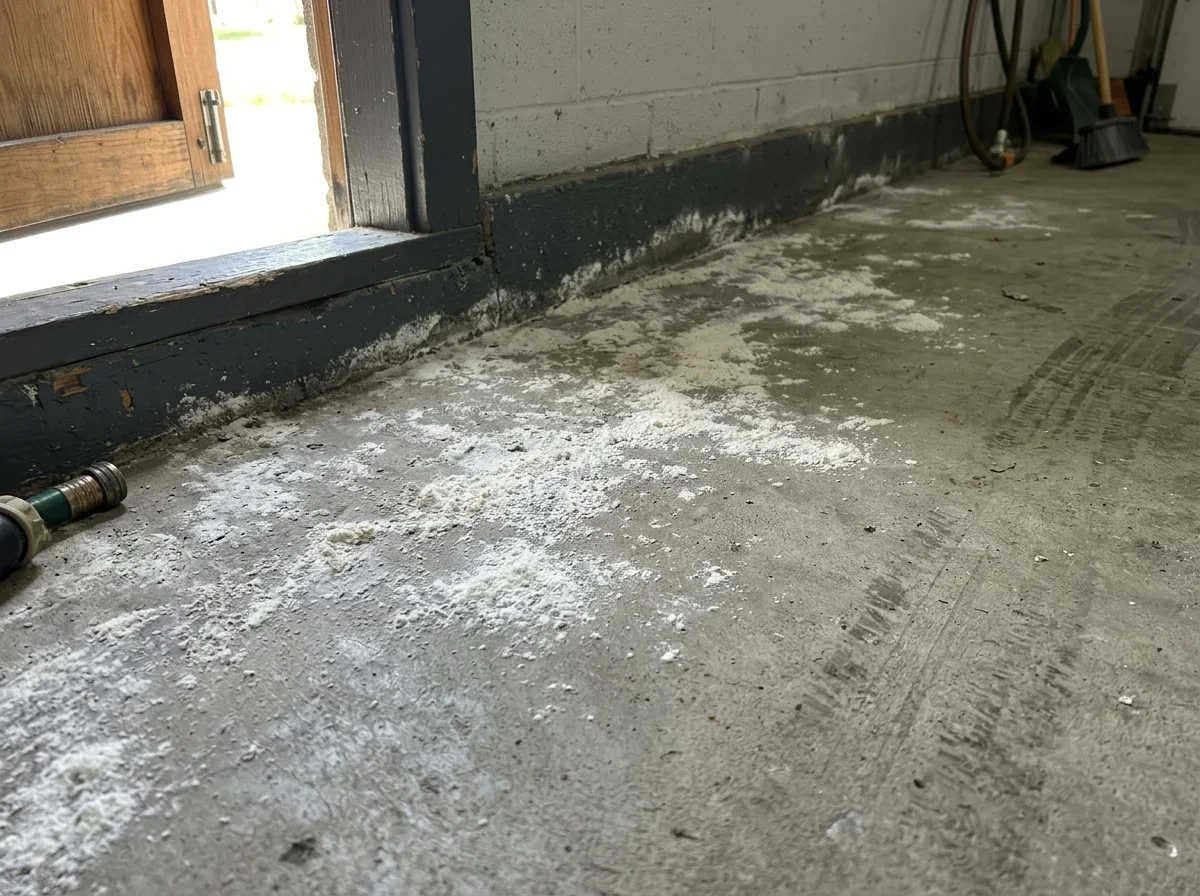
The chemistry is simple. Water entering the slab can dissolve alkali and carry it to the surface, where it reacts with carbon dioxide in the air to form carbonate salts.[3]
How it works
How efflorescence forms
Step 1: Water enters the slab
Moisture moves through the concrete
Step 2: It dissolves alkali
Salts already in the cement-based material
Step 3: Solution reaches the surface
Carried up as water moves
Step 4: Carbon dioxide forms carbonate salts
Step 5: Water evaporates, powder remains
How much shows up depends on how permeable the concrete is, how many voids it has, and how much moisture it holds.
A new slab can show efflorescence while it is still drying out. The powder alone doesn't mean the concrete is failing structurally.[2]
Moisture is the real message
Think of the white powder as a symptom. The salts are already in the cement-based material, and moisture dissolves them and lets them migrate to the surface.[4]
No water movement, no deposit.
That's why scrubbing it away rarely ends the story. If the water source is still active, the powder comes back. A deposit that returns after the surface is cleaned and dried points toward moisture moving through the slab.
Where the powder appears can hint at where to look. Deposits along the slab perimeter or wall base suggest checking grading, gutters, and downspouts. Powder tracing cracks or joints, or spread across the whole floor, suggests water coming up from below, and some older on-grade slabs may lack a vapor retarder underneath.
Treat a pattern as a clue to investigate, not a diagnosis.
Spring is a natural time to watch. Wet weather and melting snow can leave soil around a garage saturated, so check where meltwater pools at the slab edge and where downspouts discharge.
Efflorescence versus mold and road salt residue
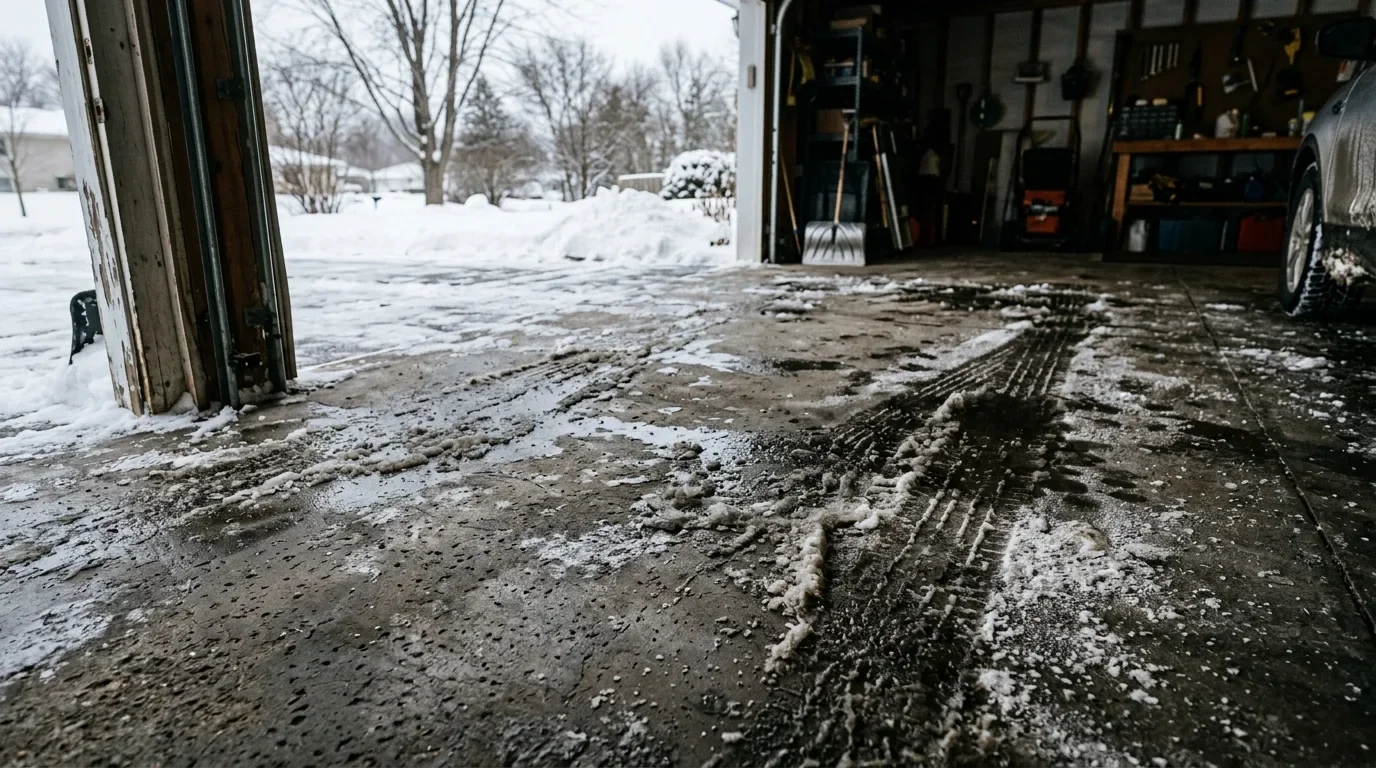
Winter adds a second salt to the picture. Vehicles carry road salt brine into the garage, and it dries into a white residue of its own. You often can't separate the two by eye, and they can overlap.
The distinction matters for a coating. Surface road salt is a contamination problem that cleaning may resolve. Efflorescence points to moisture transmission that needs testing.
| Deposit | Typical look | Where it shows | What it suggests |
|---|---|---|---|
| Efflorescence | Dry, white, crystalline or powdery[2] | Edges, cracks, joints, patches, or broadly across the slab | Water moving through the concrete |
| Mold | Usually discolored rather than bright white, may look fuzzy or smeared | Damp areas with organic material | Persistent dampness; see the EPA's mold guidance at epa.gov/mold and consider professional assessment |
| Road salt residue | White film or crust | Under wheel positions and near the overhead door | Tracked-in de-icer; clean and watch for return |
If you suspect mold, don't guess. Follow EPA guidance and have it assessed.
Hard-water mineral stains from a leaking hose or spigot can also look similar, so note whether the deposit sits near a water source.
Cleaning it off the surface
Start with the gentlest approach. Sweep or vacuum loose powder, then clean following your coating manufacturer's instructions. If you want proprietary cleaners or diluted acid, follow the product label and the maker's guidance, rinse thoroughly, and wear proper protection.
Cleaning is step one of a sequence, not the fix. Clean the slab, let it dry, wait, then re-inspect.
If the powder returns, you've learned something useful: water is still moving.
Pro tip
After cleaning, let the slab dry and re-inspect before deciding anything. Powder that comes back in the same spot tells you where to focus your search for the water source.
Before spending more time on the floor itself, look outside:
- Gutters and downspouts that dump water near the slab
- Soil that slopes toward the garage rather than away
- Driveway transitions and foundation edges where snowmelt collects
Fixing drainage can be disruptive. But repeatedly scrubbing a floor that keeps getting wet is a losing routine.
Testing the slab before coating
A coating doesn't cure a moisture problem. Before coating concrete, the moisture source should be located and corrected, and vapor or hydrostatic pressure can cause premature coating failure.[6]
Testing tells you whether the slab is ready.
Formal methods exist. One cited evaluation method is the calcium-chloride moisture test under ASTM F1869, and another is the plastic-sheet method under ASTM D4263.[6] The plastic-sheet method is simple enough to try as a screening step:
- Tape clear plastic tightly to the slab in several representative spots, including near edges and where the powder appears.
- Leave it in place as the product label directs.
- Look for condensation under the plastic or a darkened, damp patch on the concrete.
- If you see either, treat the floor as not ready and investigate further.
A clean result from a basic screen isn't a guarantee. If a contractor is quoting the job, ask what test they used, what reading they recorded, and what moisture limit the coating maker's data sheet allows.
If you're unsure where your slab stands, the floor risk assessment is a useful starting point, and our guide to basement slab moisture before epoxy covers similar warning signs.
Why coating over it fails
The mechanism is easy to picture. Water moving upward carries salts, and a coating that seals the surface traps that movement underneath. Efflorescence should not be coated over because it leaves a friable, poorly adhering base, and remaining moisture can produce hydrostatic pressure, blistering, and loss of the coating.[5]
Non-breathable paints, sealers, and coatings shouldn't go over an actively efflorescing surface because they can restrict moisture escape.[1] Salts can also keep migrating through decorative coatings and spoil their appearance.[4]
Can you just paint over it? Not while it's active.
A coating can also hide the warning sign without fixing the water problem, which makes later diagnosis harder.
Key takeaways
- Efflorescence signals moisture moving through the slab
- Cleaning removes the powder but not the water source
- Test the slab and fix the moisture source before any coating
- Coating over active efflorescence risks blistering and loss of the coating
What to ask an installer
- How was the slab moisture-tested, and what were the results?
- Does the coating maker's data sheet set a moisture limit, and is the slab under it?
- Will the surface be mechanically prepared, such as by grinding, rather than just cleaned?
- What moisture-mitigation system is planned if readings run high?
Prep and testing add to the project, which is why a quick kit often falls short. Our floor prep and repair page explains what that work involves, and garage floor epoxy covers the coating step once the slab is ready.
If a coating has already started to lift, see peeling epoxy garage floors.
Quick answers
Does efflorescence mean my garage slab is failing?
No. The powder alone doesn't mean the concrete is failing structurally, and a new slab can show it while still drying out.
Can I paint or coat over efflorescence?
Not while it's active. It leaves a poorly adhering base, and remaining moisture can cause blistering and loss of the coating.
Why does the white powder keep coming back?
Water is still moving through the slab. Cleaning removes the deposit but not the moisture source.
How can I tell efflorescence from road salt?
Often you can't by eye. Road salt shows under wheel positions and near the door, and a deposit that returns after cleaning points to moisture.
Use our free tools to estimate costs and check if your floor is ready for a coating.
Frequently Asked Questions
- American Shotcrete Association. "Controlling Efflorescence." https://shotcrete.org/wp-content/uploads/2020/05/2015Sum_TechnicalTip.pdf. Accessed October 17, 2026.
- U.S. Nuclear Regulatory Commission. "Expanded Materials." https://www.nrc.gov/docs/ML1427/ML14279A430.pdf. Accessed October 17, 2026.
- Paint & Coatings Industry. "Efflorescence: Substrate Wetting Additives Make a Difference." https://www.pcimag.com/articles/104344-efflorescence-substrate-wetting-additives-make-a-difference. Accessed October 17, 2026.
- Sika USA. "Prevention and Treatment of Efflorescence." https://usa.sika.com/dam/dms/us01/r/us-lahabra-tech-bulletin-prevention-treatment-efflorescence.pdf. Accessed October 17, 2026.
- Dulux Protective Coatings. "Concrete Floors." https://www.duluxprotectivecoatings.com.au/media/sdac0bkg/134-efflorescence.pdf. Accessed October 17, 2026.
- City of Portland Bureau of Development Services. "Moisture – Reference ASTM F1869-98 Moisture Test by use of Calcium Chloride or ASTM D4263 Plastic Sheet Method." https://www.portlandoregon.gov/bds/appeals/index.cfm?action=getfile&appeal_id=33663&file_id=43630. Accessed October 17, 2026.