
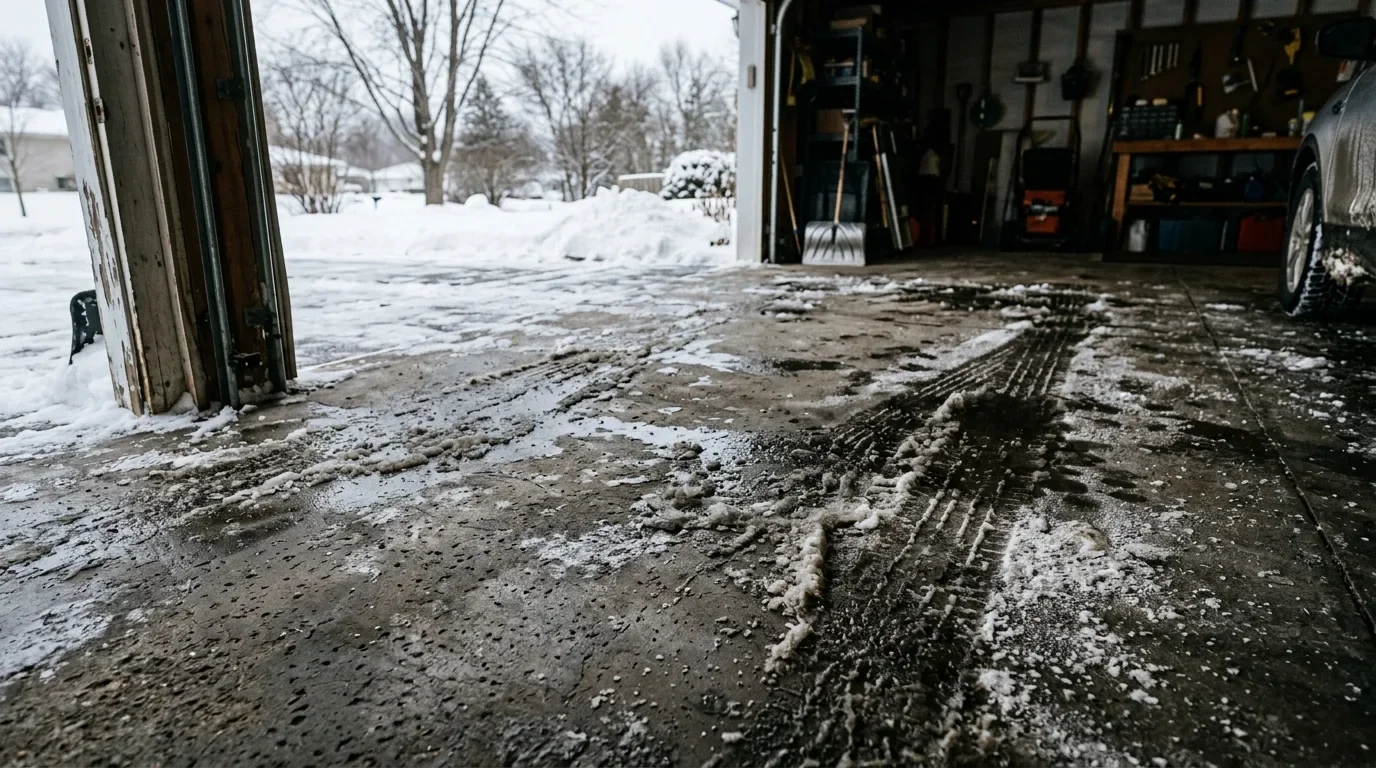
How moisture moves through a basement slab
Concrete is porous. Water vapor can travel upward through a slab as it dries, and a slab sitting on damp ground has a steady supply to draw from.[5]
Dry-looking concrete doesn't mean dry concrete.
Epoxy is impermeable. Once it cures, any vapor rising from below has nowhere to go, so the coating can trap moisture against the concrete.[1] That's the core problem with coating a basement floor.
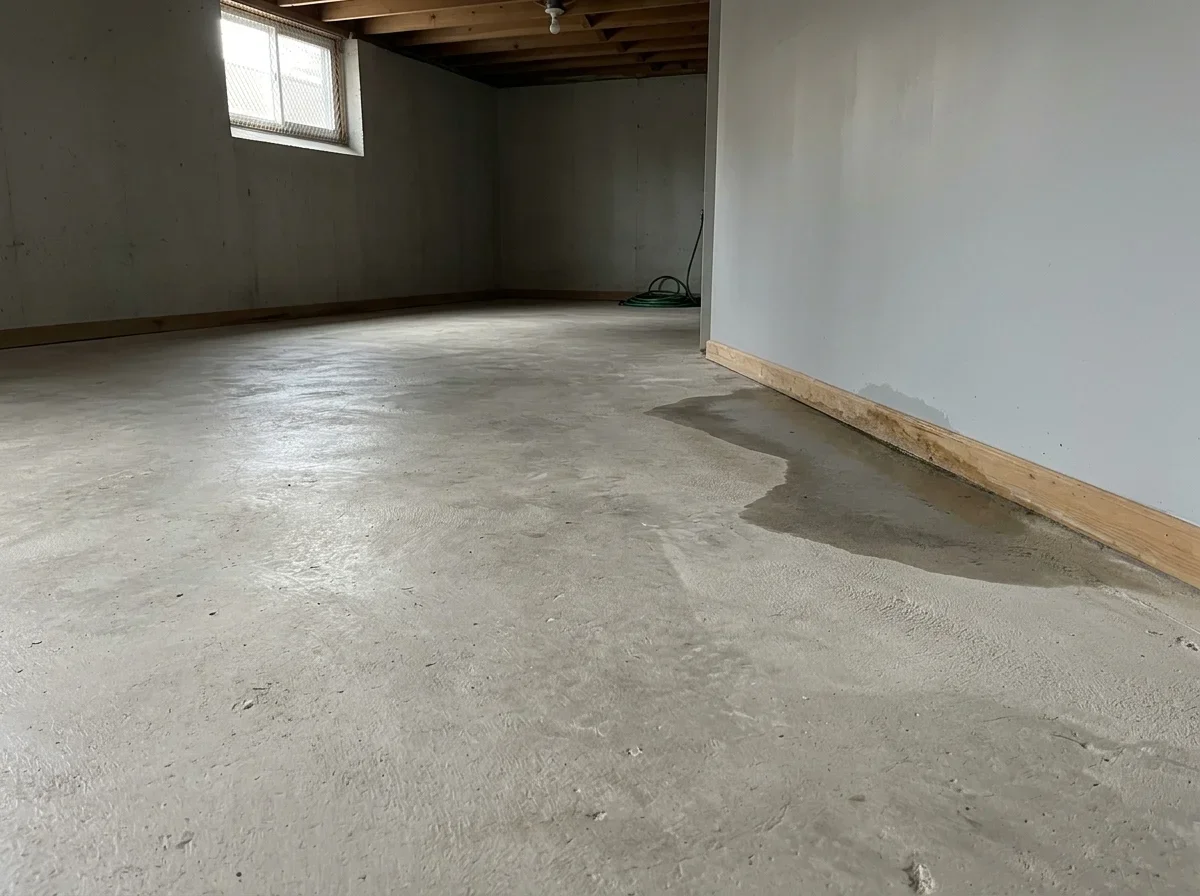
This also clears up a common mix-up. Epoxy can keep spills and water on top of the floor from soaking in, but it is not a waterproofing system for moisture coming from beneath.
A coating that blocks water from above does nothing about pressure from below.
You can epoxy a basement floor if the slab's moisture falls within the limit for the specific coating system you're using. The manufacturer sets that limit, not the test method.[2]
Warning signs on the floor and walls
Start with what you can see. Different signs point to different sources, so note where each one shows up.
On the floor:
- Dark or damp patches that come and go
- White, chalky mineral deposits (efflorescence)
- Peeling or bubbling old paint or coatings
- Cracks that look damp or stained
- Items left on the floor that feel wet underneath
On the walls and wall-floor joints:
- Water or staining where the wall meets the slab
- Musty odor
- Rust at the base of metal items such as posts or appliance feet
Small bubbles, pinholes, pitting and peeling on an existing coating can also signal trapped moisture or outgassing. They aren't always a sloppy application.[3]
Checklist
Signs to look for before coating
0 of 6 ticked
Tick them off as you go. Nothing is saved or sent.
Why a floor can look wet with no leak
Dampness without an obvious leak usually has one of a few causes: vapor passing through the slab, condensation from humid air meeting a cool surface, groundwater pressure, or a hidden plumbing or window-well leak. They look alike on the surface but need different fixes.
The plastic sheet check below helps separate the first two.
If your floor shows white powder, our guide to efflorescence before coating explains what it means. For sweating concrete, see floor condensation and coatings.
Moisture tests and what they measure
Three checks come up most often. They answer different questions, so one passing result doesn't excuse skipping the others.
The plastic sheet check
This is a screening step, not a measurement. Tape a clear plastic sheet tightly to the slab, seal all the edges, and leave it for 24 hours or more. Condensation under the plastic or a darkened patch of concrete means too much moisture for a standard system.[1]
Reading it is straightforward. Moisture on top of the plastic points to humid basement air condensing. Moisture underneath points to vapor or water coming through the slab.
How it works
How the plastic sheet check works
Step 1: Tape clear plastic tightly to the slab
Seal all the edges
Step 2: Leave it for 24 hours or more
Step 3: Check for moisture or darkening
On top means humid air; underneath means vapor or water from the slab
A clean sheet is encouraging, but it doesn't give you a number.
ASTM F1869 and ASTM F2170
ASTM F1869 is the calcium chloride test. It measures moisture-vapor emission from the prepared slab surface, in pounds per 1,000 square feet per 24 hours.[2] ASTM F2170 uses probes set inside the slab to measure internal relative humidity.[2]
The two results complement each other, and neither standard sets one universal pass/fail line for epoxy.[4] Testing several areas of the floor matters too, since one spot won't represent the whole slab.[1]
Ask for documented results, then compare them with the technical data sheet for the exact product going on your floor. That sheet is where the allowable limit lives.
What moisture does to a coating
The failure follows a simple chain. Vapor keeps rising, the cured coating blocks it, and pressure builds at the bond line between coating and concrete. The result is bubbling, blistering, peeling or delamination.[1]
Timing is what catches people off guard. A floor can look fine at first and fail months later, especially when wetter conditions raise the moisture load.[1]
That's why a quick look right after installation proves very little.
Repairs are rarely a spot fix. Damaged areas generally have to come out, the concrete gets re-prepared, and the moisture source has to be controlled. Sometimes the whole floor is recoated so the finish looks uniform.[4]
Decorative and metallic systems tend to show vapor problems more visibly, since pinholes and outgassing disturb the finish.[3]
Moisture-tolerant primers and when they are not enough
If testing shows elevated moisture, the usual responses are a moisture-vapor-barrier primer, a coating designed for high-moisture conditions, or a more breathable finish.[3] These are mitigation, not a cure, and each works only within its stated limits.
Here's a practical way to read your results:
- Sheet check clean, quantitative tests within the product's limit: the slab is a reasonable candidate for coating, with proper preparation.
- Mild or intermittent dampness: ask about a manufacturer-approved moisture-mitigation primer or vapor-control system, not a standard epoxy primer.
- Visible water, seepage or persistent wetness: stop and fix the source first. No primer is a substitute for stopping active water.
Ask exactly which primer or system will be used and what moisture range it allows. "Epoxy" alone isn't a specification.
How serious is it
Level 1 of 3: Within limits
Signs Clean sheet check and tests within the product's limit
What to do Coat with proper preparation
Level 2 of 3: Mild dampness
Signs Mild or intermittent dampness
What to do Ask about an approved moisture-mitigation primer or vapor-control system
Level 3 of 3: Active water
Signs Visible water, seepage or persistent wetness
What to do Stop and fix the source first
Then ask what happens if moisture later exceeds the tested range, and whether the warranty covers vapor-related failure.
Fix the water source first
Coating over an active water problem can simply move the failure to the coating edges or walls. Epoxy can't resist hydrostatic pressure, active seepage or poor drainage, and it can't make up for a missing or failed vapor barrier under the slab.
Start outside. Extend downspouts, repair gutters, and improve grading so water moves away from the foundation. If the slab still gets wet, drainage or other waterproofing work may be needed before any coating goes down.
Timing your evaluation helps. Wet weather and shifting groundwater can reveal moisture that a dry spell hides, so inspect during or after heavy rain or spring thaw if you can.
Pro tip
Check the slab during or just after heavy rain, when hidden moisture is most likely to show, and note exactly where it appears.
Look for damp spots, efflorescence, musty odors and water at the wall-floor joints before scheduling work.
Once the water source is handled and your tests fall within the product's limits, grinding or shot blasting prepares the slab for coating. See our floor prep and repair page for what that involves, or use the floor risk assessment to check slab readiness. When you're ready, our basement floor coating service covers the next step.
Quick answers
Can you epoxy a basement floor?
Yes, if the slab's moisture falls within the limit for the specific coating system. The manufacturer sets that limit.
Does epoxy waterproof a basement floor?
No. It can keep spills on top from soaking in, but it is not a waterproofing system for moisture coming from beneath.
Is the plastic sheet check enough?
No. It is a screening step that gives no number, so quantitative tests are still needed.
What if moisture is too high?
Ask about a manufacturer-approved moisture-mitigation primer, and fix any active water source first.
Check whether your floor is ready for a coating before you call installers: a free 2-minute assessment.
Frequently Asked Questions
- Sherwin-Williams. "How Soon Can You Epoxy Coat Freshly Poured “Green” Concrete?." https://industrial.sherwin-williams.com/na/us/en/resin-flooring/contractor-center/technical-articles/epoxy-coat-freshly-poured-green-concrete.html. Accessed October 17, 2026.
- Sparco. "Concrete Moisture Test Before Coating — F2170 vs F1869." https://www.sparcoasia.com/en/resources/concrete-moisture-testing-before-coating. Accessed October 17, 2026.
- Anvil Field. "Concrete sealers and coatings field guide: protect the slab." https://anvilfield.com/field-guides/concrete/concrete-sealers-coatings-protection/. Accessed October 17, 2026.
- Louisville Coating. "ASTM F2170 vs. ASTM F1869: Two Ways to Evaluate Concrete Moisture." https://louisvillecoating.com/astm-f2170-vs-f1869/. Accessed October 17, 2026.
- Anvil Field. "Epoxy and resinous floor coating install field guide." https://anvilfield.com/field-guides/concrete/epoxy-resinous-floor-coating-install/. Accessed October 17, 2026.