
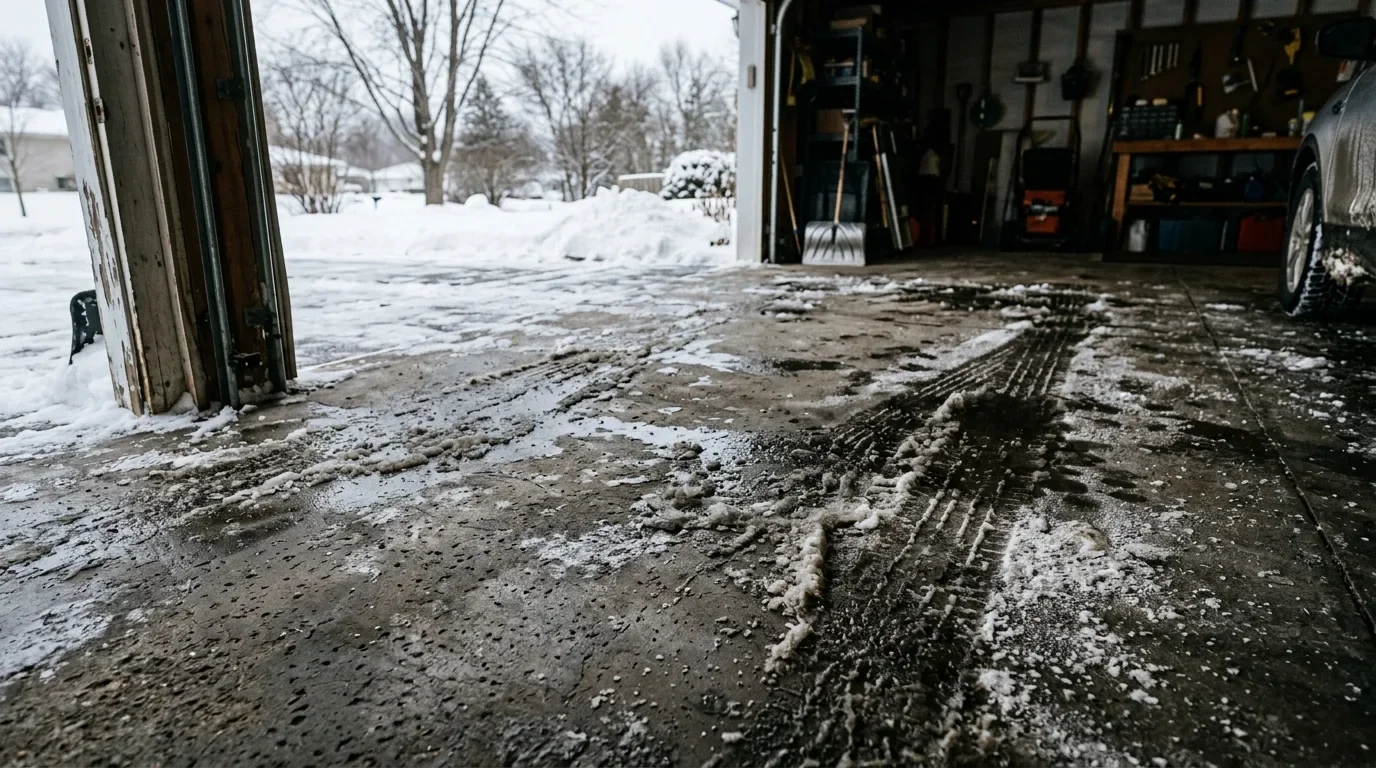
Why a cool slab collects moisture from the air
Air holds water vapor, and the amount it can hold drops as it cools. The dew point is the temperature at which that vapor begins to condense into liquid.[1] If a surface is colder than the dew point of the air touching it, water forms on that surface.
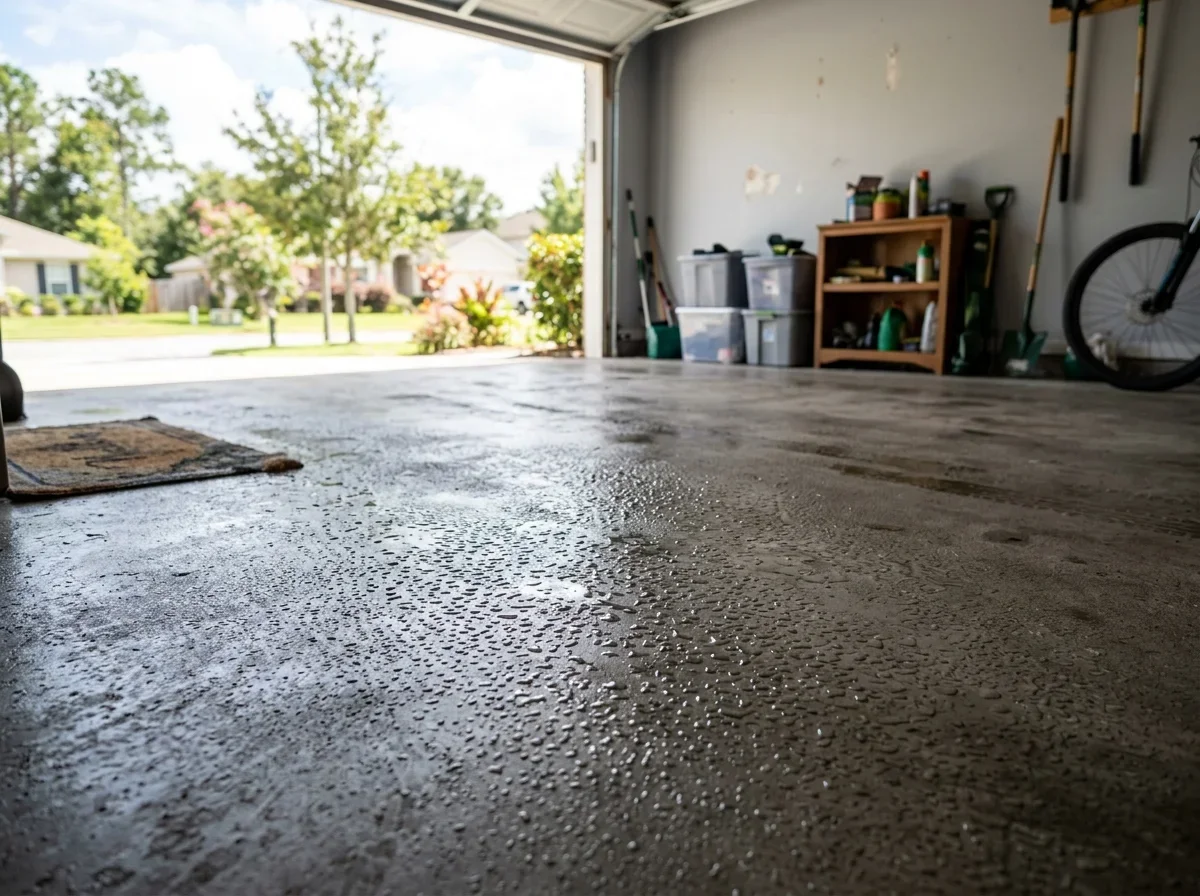
This is why relative humidity alone can mislead you. What matters is the gap between the slab's surface temperature and the air's dew point.
Why the slab lags behind the air
Concrete has high thermal mass, so it warms slowly. A slab that sat through a long cold stretch can stay cool long after the air outside turns warm. Then a humid spell arrives, the dew point climbs above the slab's temperature, and the floor starts to bead up.
That lag explains why the problem comes and goes. It often clears on its own once the slab catches up or the weather dries out.
Everyday habits add to it. Opening the garage door on a humid day lets warm, wet air roll across a cold floor. A car that comes in wet from rain adds more moisture.
Telling condensation from seepage
Water on a slab can come from the air, from vapor moving up through the concrete, or from water entering around it. The sheet check is the simplest way to separate the first from the others. Dry a patch of the floor, tape a piece of clear plastic over it with the edges sealed, and leave it in place.
Moisture on top of the plastic points to condensation from room air. Moisture underneath points to vapor coming through the slab. Coating manufacturers reference a plastic-sheet method for indicating concrete moisture, identified as ASTM D4263.[3]
How it works
How the plastic sheet check works
Step 1: Dry a patch of floor
Step 2: Tape clear plastic over it with sealed edges
Step 3: Leave it in place
Step 4: Check which side the moisture is on
On top means condensation; underneath means vapor from the slab
Treat it as a screening check only. Coating makers rely on formal moisture-vapor testing, such as the calcium-chloride dome method described in Sika's preparation guidance.[3]
Pattern and timing give you more clues than the sheet alone:
| Observation | Condensation | Seepage or vapor from below |
|---|---|---|
| Pattern | Broad, fairly even wetness | Concentrated near walls, cracks, joints, or one low spot |
| Timing | Follows warm, humid weather; clears when conditions change | Follows rain or snowmelt; lingers |
| Plastic sheet | Moisture on top | Moisture underneath |
| Other signs | Wet near the door line and under parked cars | Stains, white mineral deposits, musty smell |
Both can happen at once, so a clean result on one check doesn't rule out the other.
Ventilation, dehumidifying and insulation
The goal is simple: keep the slab surface above the dew point of the surrounding air. You can do that by lowering the moisture in the air, by limiting how fast the temperature swings, or by warming the space.
Start with the door. Keep it closed on humid days when you can, and seal obvious air leaks at the door edges and any shared wall.
A dehumidifier sized for the space removes moisture from the air directly, which lowers the dew point.
Ventilation is the part people get wrong. Fans move air, but if that air is humid and the slab is cold, you may just be delivering more moisture to the surface.
Pro tip
Keep the door shut and use a dehumidifier on humid days rather than relying on fans, which can push wet air across a cold slab.
Insulating the garage envelope and door slows temperature swings, so the slab and the air stay closer together.
Sealers and coatings are a different category. They don't stop humid air from condensing on top. Spend on waterproofing only after you've confirmed moisture is coming from below.
Safety on a wet slab
A wet slab is a slip hazard, and sealed, painted, or polished concrete gets slicker still. Wipe the floor before you carry anything heavy across it.
Wet floors also affect what's stored on them. Cardboard, tools, and the underside of a vehicle can pick up rust or mildew. Lift storage off the slab where you can.
If you run a dehumidifier, keep its cord and plug out of standing water, and don't stretch an extension cord across a wet floor.
What condensation means for coating work
This is where sweating costs people money. A coating needs a dry, clean surface, and product data sheets set a temperature margin above dew point during application.
Hempel's data sheet calls for a clean, dry surface at least 5°F (3°C) above the dew point.[2] Sika's concrete primer sheet requires the substrate to be dry and free of condensation, with air, substrate, and uncured coating all held at least 5°F (3°C) above the dew point.[4]
Sika's preparation guidance warns that condensation-related moisture can cause poor adhesion, delamination, poor curing, and other failures.[1] Those margins vary by product, so use the technical data sheet for the system you plan to apply.
Don't coat just because the floor looks dry. A slab that looks dry in the morning can sweat again by afternoon, so postpone the job during humid stretches.
If you're weighing a coating, read best epoxy for garage floors for how products differ, and use the floor risk assessment to check slab readiness first. Cold-slab limits are covered in epoxy garage floors in winter, and slab testing in basement slab moisture before epoxy.
When a wet floor needs a professional look
Surface condensation alone usually isn't structural. Persistent moisture can point to something else, such as drainage trouble or a problem with what's under the slab.
Call someone in if you see:
- White, chalky mineral deposits on the surface or along the walls
- Standing water that follows rain or snowmelt
- A musty smell that doesn't clear
- Spalling or flaking concrete
- Dampness rising at the base of walls
- A plastic sheet that collects moisture underneath
Before you spend on waterproofing, have the source diagnosed. Downspouts, grading, and cracks are separate issues from condensation.
Checklist
Signs to get a professional look
0 of 6 ticked
Tick them off as you go. Nothing is saved or sent.
If the slab needs crack repair or surface work before it can be coated, that falls under floor prep and repair. Once the slab tests dry, a garage floor epoxy installer can coat it, and the epoxy garage floor cost guide explains how quotes are built.
Quick answers
What causes condensation on a concrete floor?
Concrete that is colder than the dew point of the surrounding air.
Why is my garage floor sweating so bad?
A slab that stayed cold while humid air moved in will sweat heavily. Open doors, wet vehicles, and poor air sealing make it worse.
How do I stop condensation on my garage floor?
Keep humid air out, run a dehumidifier, and moderate temperature swings with insulation. Fans alone can bring in more moisture than they remove.
What can I put on my concrete floor to keep moisture out?
Sealers and coatings don't prevent condensation on the surface. Test first, and read the product data sheet for its moisture and dew-point limits.
Use our free tools to estimate costs and check if your floor is ready for a coating.
Frequently Asked Questions
- Sika. "Sikafloor Surface Preparation Guide." https://usa.sika.com/content/dam/dms/us01/j/sikafloor-surface-prep-guide.pdf. Accessed October 17, 2026.
- Hempel. "Hempaline Defend 630 LT Product Data Sheet." https://www.hempel.com/en-us/api/Hempel/DataSheet/PDS/Download/37822/en-US. Accessed October 17, 2026.
- Sika. "Sikafloor Surface Preparation Guide." https://usa.sika.com/content/dam/dms/us01/j/sikafloor-surface-prep-guide.pdf. Accessed October 17, 2026.
- Sika. "Product Data Sheet: Sika Concrete Primer Lo-VOC." https://usa.sika.com/dam/dms/us01/y/sika_concrete_primerlo-voc.pdf. Accessed October 17, 2026.